
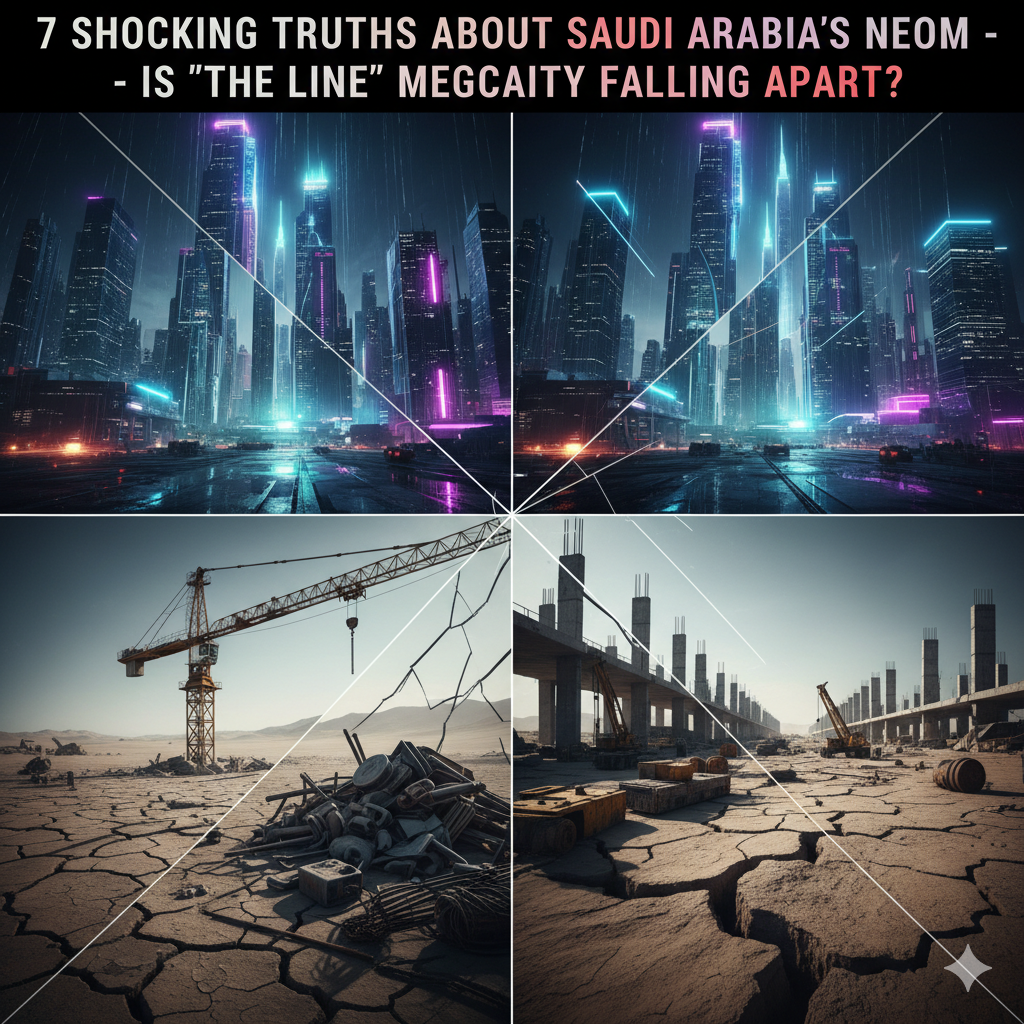

Is Saudi Arabia Drawing a Line Through Its NEOM Futuristic Megaproject?
Saudi Arabia’s NEOM — once hailed as the boldest urban experiment on Earth — now faces an existential crisis. The crown jewel of Crown Prince Mohammed bin Salman’s Vision 2030, known as “The Line”, was meant to redefine how humanity lives. Stretching across 170 kilometers of desert, this linear city promised to blend cutting-edge architecture, zero-carbon technology, and AI-driven sustainability into one breathtaking megastructure.
Yet, new reports suggest the futuristic dream is fading fast.
The Dream: A City Like No Other
When The Line was first unveiled in 2021, it was described as “a blueprint for the future of human civilization.” A city with:
- A 170 km linear structure cutting through the desert
- A population capacity of 9 million people
- Vertical living spaces powered by renewable energy
- A floating football stadium and five-runway airport
- A colossal marina where cruise ships could glide beneath futuristic sky bridges

The estimated cost at launch: $500 billion.
The updated projection in 2025: over $4.5 trillion.
The Reality: Billions Spent, Dreams Delayed
According to The Financial Times, construction has slowed dramatically. Architects and planners are now questioning if the ultra-futuristic design can even be built.
“As a thought experiment, great. But don’t build thought experiments,”
— Urban Planner in Saudi Arabia (FT interview)
What’s Happening Now:
- Piling work has begun — metal columns driven deep into desert sand.
- $50 billion already spent on groundwork.
- Focus shifted to smaller projects near the marina — the only visible progress so far.
But the “line” itself — a 500-meter-high, 200-meter-wide wall of glass cutting across the desert — appears increasingly impossible.
The Engineering Challenges: Impossible or Impractical?
Experts say several design flaws make The Line almost physically unbuildable:
- Structural Instability: A massive overhanging chandelier-style structure across the marina is deemed “physically impossible.”
- Artificial Water Circulation: The marina lacks a natural current, requiring enormous pumps to prevent stagnation — a major environmental hazard.
- Unrealistic Transit: A high-speed train covering 170 km in 20 minutes leaves no time for stops — passengers would have to send luggage hours in advance.
Each of these elements exposes the logistical nightmare behind the glossy renderings.
The Financial Strain: A Billionaire’s Burden
Saudi Arabia’s economy remains heavily dependent on oil. With lower oil prices and Public Investment Fund (PIF) returns still pending, funds for NEOM are tightening.
The material demand alone for The Line could overwhelm global supply chains, driving up steel, concrete, and glass costs worldwide.

One insider estimated:
“To complete 12 modules of The Line by 2030, a 40-foot container would need to arrive every eight seconds, 24/7.”
Such logistics border on the impossible.
NEOM’s Future: Scaling Back the Vision
While Riyadh publicly insists the project continues, insiders reveal massive scaling down of expectations. The original dream of a continuous 170 km city might be replaced by clustered modules or independent hubs — still futuristic, but more realistic.
Even so, Crown Prince Mohammed bin Salman remains steadfast in his Vision 2030, emphasizing diversification through real estate, entertainment, and technology rather than solely oil revenue.
Check Also: Marshawn Kneeland death Rumors Die 24 Football cowboys player
What “The Line” Means for the Future of Urban Design
NEOM’s struggles reveal deeper questions about humanity’s approach to sustainable urbanization. Can technology truly outpace nature’s constraints? Is visionary architecture without feasibility still worth the effort?

While “The Line” might remain unfinished, it undeniably reshaped global discussions on urban innovation, AI-driven cities, and post-oil economies.
Source:
FAQs About NEOM and “The Line”
Q1: What is The Line in Saudi Arabia?
A: The Line is a proposed 170 km linear smart city within the NEOM region, designed to house 9 million people in a zero-carbon environment.
Q2: Why is The Line facing delays?
A: Engineering challenges, high costs, and logistical constraints have caused major delays and forced Saudi Arabia to scale back.
Q3: How much has The Line cost so far?
A: As of 2025, the project has cost over $50 billion, with total projections reaching $4.5 trillion.
Q4: Will NEOM still continue despite The Line’s issues?
A: Yes. Saudi Arabia continues to develop smaller NEOM subprojects like Oxagon and Trojena while revising The Line’s master plan.
Q5: Is The Line still part of Vision 2030?
A: Absolutely. It remains a symbolic part of Saudi Arabia’s Vision 2030, though on a potentially reduced scale.
From Vision to Reality — Or Illusion?

Saudi Arabia’s NEOM project, particularly The Line, stands at a crossroads between futuristic ambition and architectural reality. Whether it becomes a modern marvel or a cautionary tale will depend on the nation’s adaptability and engineering breakthroughs.
For now, The Line remains a shimmering mirage in the desert — a glimpse of what could have been humanity’s boldest experiment in living.