
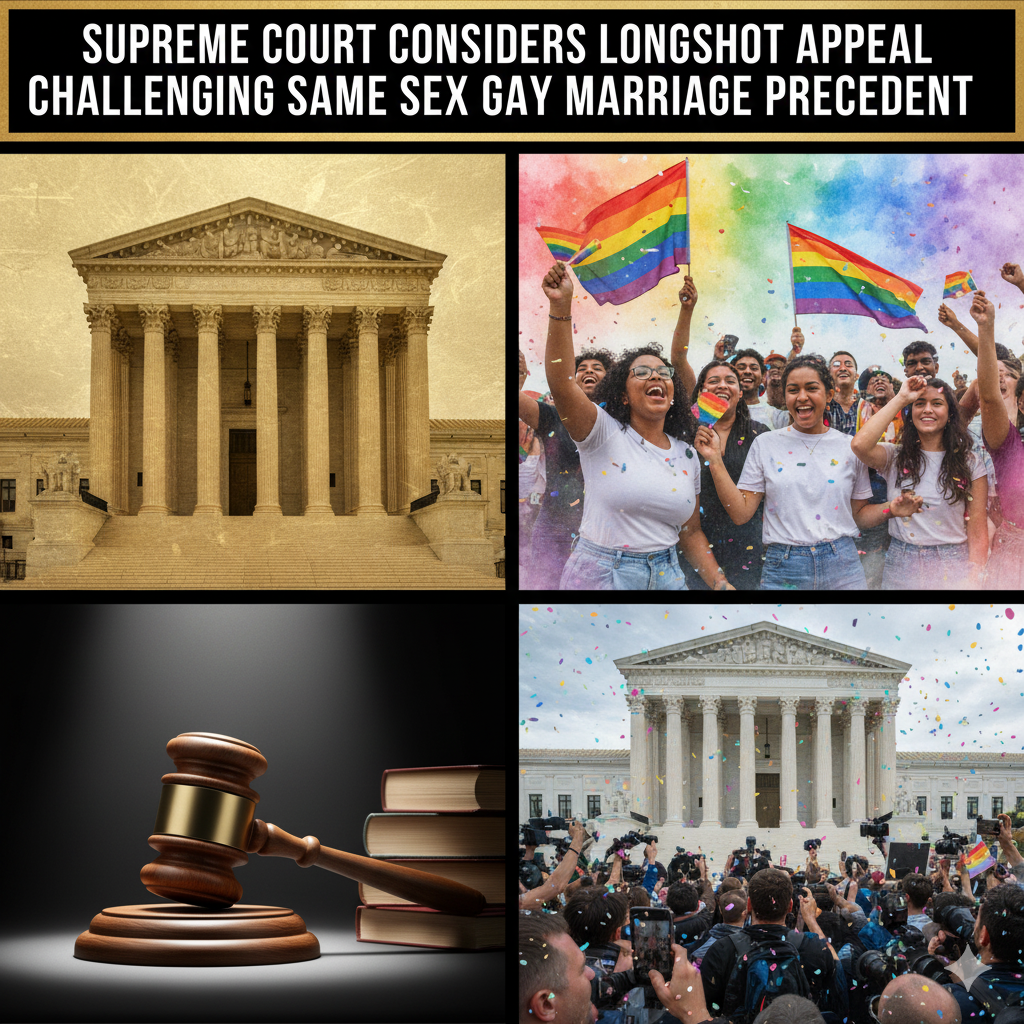

Supreme Court Weighs Appeal That Could Challenge Same Sex Gay Marriage
The U.S. Supreme Court is set to meet behind closed doors this Friday to consider a high-profile appeal that seeks to overturn the landmark same-sex marriage ruling, Obergefell v. Hodges, decided in 2015. While the appeal has stirred concern among LGBTQ advocates, experts caution that the court has shown little inclination to revisit the precedent in its current composition.
The case comes from Kim Davis, a former county clerk in Kentucky who refused to issue marriage licenses following the Supreme Court’s historic decision. Davis has persistently pursued her legal battle and is now directly asking the court to invalidate the Obergefell decision, describing it as needing a “course correction.”
What the Appeal Entails
The Supreme Court considers dozens of appeals during its closed-door conferences, determining which cases it will hear and which it will deny. The Davis case is among those under review, and the court could announce its decision as early as Monday. Alternatively, the court may hold the appeal for several weeks, as justices sometimes require time to draft opinions even when declining to hear a case.

James Obergefell, the plaintiff who lent his name to the 2015 decision, expressed concern this week. “At this point, I do not trust the Supreme Court,” Obergefell told CNN.
Changes in the Supreme Court Since Obergefell
The Supreme Court of 2025 differs significantly from the one that ruled on Obergefell v. Hodges. Key justices who authored and supported the original decision have retired:
- Justice Anthony Kennedy, the pivotal swing vote in Obergefell, retired in 2018 and was replaced by Justice Brett Kavanaugh, a conservative.
- Justice Ruth Bader Ginsburg, a liberal icon and Obergefell supporter, passed away in 2020 and was succeeded by Justice Amy Coney Barrett.
Despite previous comments from some conservative justices—such as Justice Clarence Thomas, who once called for a reconsideration of Obergefell—the court has also signaled caution. Justice Barrett emphasized the importance of “concrete reliance interests” affecting family law, child custody, and financial planning.
Justice Samuel Alito, who dissented in Obergefell, recently reaffirmed the principle of stare decisis, underscoring the importance of respecting established precedent.
Impact and Public Response
The Obergefell ruling marked a historic moment for same-sex marriage in the United States, leading to nearly 600,000 marriages, according to the Williams Institute at UCLA. The decision prompted celebrations outside the Supreme Court and symbolic gestures like the White House lighting up in rainbow colors.

However, not everyone welcomed the ruling. Kim Davis cited religious objections and was sued for refusing to issue licenses. A jury awarded damages exceeding $100,000, and a federal court ordered her to comply, temporarily resulting in her imprisonment for defying the court order.
Legal Nuances of the Davis Case
While much attention focuses on Davis’ request to overturn Obergefell, her appeal also challenges the damages verdict on First Amendment grounds. Davis argues her religious beliefs should protect her from legal liability now that she is no longer a public official. The 6th U.S. Circuit Court of Appeals rejected this argument, leaving the matter for potential Supreme Court review.
It is unclear whether the court will take up the case or simply address the technical aspects without reconsidering Obergefell. Legal experts note that overturning a precedent requires careful deliberation and a majority of five justices willing to act.
Check Also: Claudia Sheinbaum Assault – Mexico Women Demand Justice
The Future of Same Sex Gay Marriage
Some advocates view the appeal as the beginning of a longer-term effort against Obergefell, akin to the strategy that ultimately overturned Roe v. Wade. While Congress passed federal protections for same-sex marriage in 2022, religious opposition remains influential in legal and political circles.

Mathew Staver of Liberty Counsel, representing Davis, warned, “If not this case, it’s going to be another case. In my view, it’s not a matter of if but when it will be overturned.” Civil rights attorneys, however, stress ongoing vigilance. Mary Bonauto of GLAD Law said, “You can never really rest on your laurels because other forces just don’t give up.”
Source:
Judgment:
The Supreme Court’s review of the Kim Davis appeal underscores the ongoing legal and cultural debates surrounding same sex gay marriage. While the court may decline to hear the case, the attention highlights both the progress and vulnerabilities of LGBTQ rights in the United States.
For now, Obergefell v. Hodges remains the law of the land, but legal experts and advocates alike continue to watch for developments that could shape the future of gay marriage in America.


