


Introduction – What You Need to Know About Daylight Saving Time in Canada
Every March and November, Canadians experience the familiar clock change that marks the beginning and end of Daylight Saving Time (DST) — a practice designed to make better use of daylight during warmer months.
In 2025, most provinces across Canada will again “spring forward” and “fall back,” though a few have chosen to opt out. Understanding the Daylight Saving Time Canada 2025 schedule is essential for travelers, business owners, and residents who rely on time accuracy across different time zones.
🗓️ Highlight – Quick Overview of DST 2025 in Canada
| Event | Date (2025) | Action |
|---|---|---|
| DST Starts | Sunday, March 9, 2025 | Clocks move forward 1 hour at 2:00 a.m. |
| DST Ends | Sunday, November 2, 2025 | Clocks move back 1 hour at 2:00 a.m. |
That means Canadians will enjoy longer daylight evenings from March to early November — nearly 8 months of brighter evenings for outdoor activities, travel, and work-life balance.
🧭 History of Daylight Saving in Canada
Daylight Saving Time has been part of Canadian life since 1908, when Port Arthur, Ontario (now Thunder Bay) became one of the first cities in the world to adopt it. The idea spread across the nation during World War I, aiming to conserve energy and maximize daylight.
Today, most provinces follow the March–November DST pattern, aligning with the United States to ensure time consistency across the North American economy.

🕐 Why Does Canada Still Observe DST?
While many countries have abandoned daylight saving, Canada continues to observe it to maintain synchronization with U.S. markets, air travel schedules, and cross-border trade.
Provinces like Ontario, Quebec, and British Columbia find DST beneficial for energy management and evening productivity, though public opinion remains divided.

🧩 Fact #1 – Not All Provinces Observe Daylight Saving Time
Contrary to popular belief, not every province changes their clocks in 2025. Saskatchewan remains the most notable exception, keeping Central Standard Time (CST) all year round.
Meanwhile, parts of British Columbia, Nunavut, and Quebec also stay on standard time depending on local municipalities.
This variation can lead to confusion for travelers — especially those crossing provincial borders or booking flights across time zones.

🧩 Fact #2 – DST 2025 Start Date: Sunday, March 9
On March 9, 2025, Canadians will set their clocks forward one hour at 2:00 a.m. local time, marking the beginning of Daylight Saving Time.
This “spring forward” shift results in one less hour of sleep — but also means longer, brighter evenings perfect for outdoor dining, travel, and sports.
🧩 Fact #3 – DST 2025 End Date: Sunday, November 2
On November 2, 2025, at 2:00 a.m., clocks will “fall back” by one hour, giving Canadians an extra hour of rest and marking the return to Standard Time.
This transition often brings shorter days and earlier sunsets, symbolizing the seasonal shift toward winter.

🧭 Fact #4 – British Columbia’s Pending Move to Permanent DST
British Columbia passed legislation to stay permanently on Daylight Time but is waiting for U.S. states like Washington, Oregon, and California to make the same move for consistency.
Until then, BC will continue to adjust its clocks in March and November 2025.
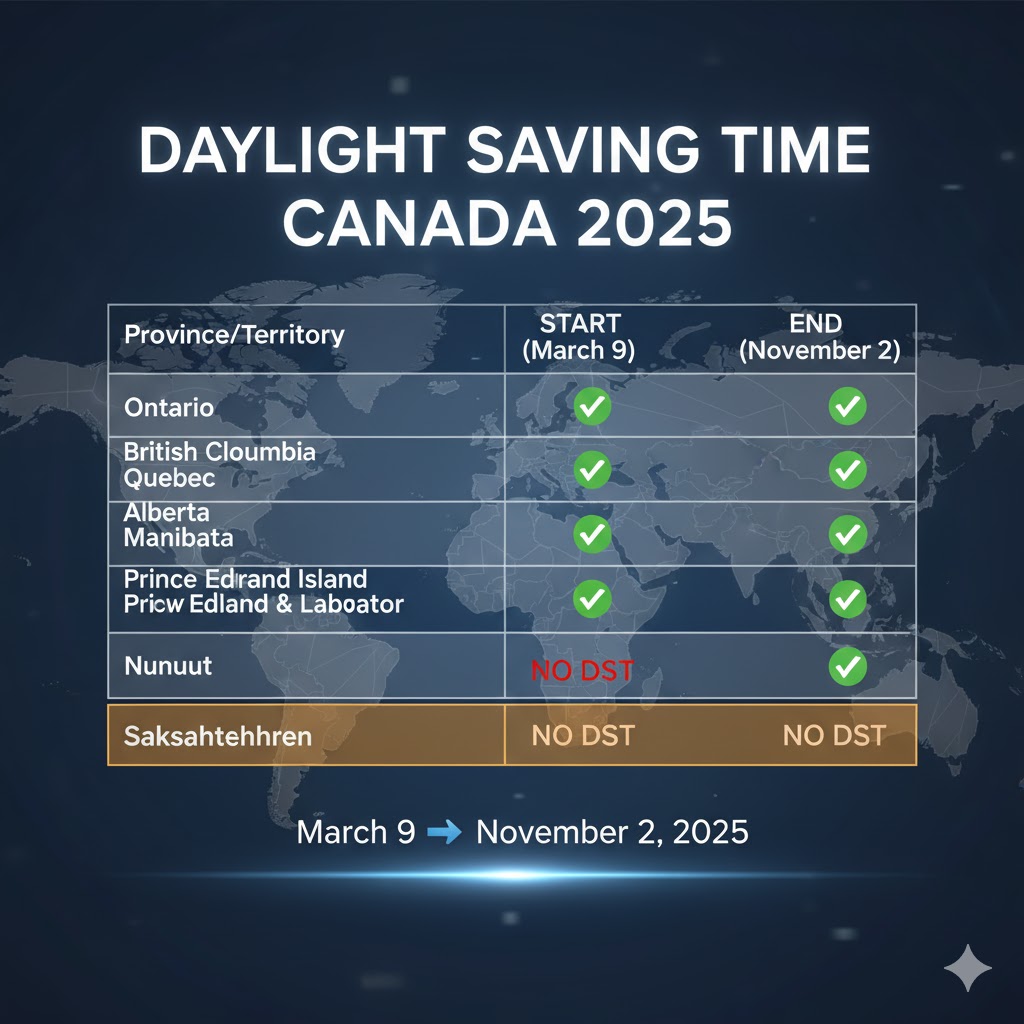
Fact #5 – Province-by-Province Daylight Saving Time Schedule (2025)
Canada spans six primary time zones, and not every province observes Daylight Saving uniformly. Below is a province-by-province breakdown of the DST start and end dates for 2025, including exceptions.
| Province/Territory | DST Start (2025) | DST End (2025) | Observes DST? |
|---|---|---|---|
| British Columbia | March 9 | November 2 | Yes (except some northern areas) |
| Alberta | March 9 | November 2 | Yes |
| Saskatchewan | — | — | ❌ No (remains on CST year-round) |
| Manitoba | March 9 | November 2 | Yes |
| Ontario | March 9 | November 2 | Yes |
| Quebec | March 9 | November 2 | Yes (except parts of Côte-Nord) |
| New Brunswick | March 9 | November 2 | Yes |
| Nova Scotia | March 9 | November 2 | Yes |
| Prince Edward Island | March 9 | November 2 | Yes |
| Newfoundland & Labrador | March 9 | November 2 | Yes |
| Nunavut | March 9 | November 2 | Partial (varies by region) |
| Yukon | — | — | ❌ No (permanent DST since 2020) |
| Northwest Territories | March 9 | November 2 | Yes |
As shown, Saskatchewan and Yukon stand apart — Saskatchewan sticks to Standard Time, while Yukon remains permanently on Daylight Time throughout the year.
🧩 Fact #6 – How DST Affects Canadian Travelers and Flights
The time shift impacts flight schedules, hotel bookings, and cross-border travel. Airlines automatically adjust departure and arrival times, but travelers booking around March 9 or November 2 should double-check their itinerary.
For example, a flight from Vancouver to Toronto may appear one hour shorter or longer, depending on the DST phase.
🧩 Fact #7 – How to Prepare for Daylight Saving Time Change
Adjusting your schedule ahead of time helps minimize fatigue and confusion. Here are simple pre-DST tips:
- Set clocks forward the night before the change.
- Gradually shift your sleep schedule by 15 minutes for 3–4 days.
- Avoid heavy caffeine the night before the switch.
- Sync your digital devices (phones, watches, computers) automatically.
- Update time-sensitive appointments or travel bookings.
These small adjustments make the Daylight Saving Time Canada 2025 transition smoother and more energy-efficient.
🧩 Fact #8 – The Health and Productivity Debate
DST is meant to save daylight, but studies show mixed effects. Many Canadians report better mood and outdoor activity levels in summer months — yet some research links time changes to short-term sleep loss and reduced concentration.
Health experts recommend early adaptation and exposure to morning sunlight to help the body adjust faster.
🧩 Fact #9 – Calls to End Daylight Saving in Canada
Public debate over ending DST has intensified since 2020. Provinces like British Columbia and Ontario have already passed legislation to make permanent Daylight Time, but both await coordination with neighboring U.S. states to avoid trade and timing inconsistencies.
If the U.S. federal government approves the Sunshine Protection Act, Canada is likely to follow suit in the coming years — potentially making 2025 or 2026 the last traditional DST cycle.
🧩 Fact #10 – How DST Impacts Businesses and Energy Use
While originally introduced to save electricity, today’s impact is less clear. Businesses enjoy longer evening hours, especially in retail and tourism, boosting sales and customer activity.
However, studies suggest modern electricity use patterns differ from the early 1900s — meaning the economic benefit of DST is smaller but still noticeable in certain sectors.
Digital systems like stock markets, logistics, and online scheduling tools now automatically adjust to time zone changes, minimizing operational disruption.

💡 Key Takeaway
Daylight Saving Time in Canada continues to blend tradition and practicality, balancing energy savings, business alignment, and lifestyle benefits. While debate continues, DST in 2025 will again bring longer days, shorter nights, and a collective clock shift that marks Canada’s seasonal rhythm.
Frequently Asked Questions (FAQs)
1. When does Daylight Saving Time start in Canada in 2025?
Daylight Saving Time (DST) in most Canadian provinces begins on Sunday, March 9, 2025, at 2:00 a.m., when clocks are moved forward one hour. This marks the shift to longer daylight hours and the start of the summer time schedule.
2. When does Daylight Saving Time end in Canada in 2025?
DST ends on Sunday, November 2, 2025, at 2:00 a.m., when clocks are turned back one hour to return to standard time. This change allows for brighter mornings during the winter months.
3. Which provinces in Canada do not observe Daylight Saving Time?
Saskatchewan and most of Yukon do not observe Daylight Saving Time. These regions remain on standard time year-round to simplify local schedules and business operations.
4. Why does Canada use Daylight Saving Time?
DST was introduced to make better use of daylight during the longer days of spring and summer. It helps conserve energy, enhances road safety, and benefits industries like tourism and agriculture that rely on daylight hours.
5. Do smartphones and computers automatically adjust for DST in Canada?
Yes. Most modern digital devices automatically update their clocks based on network time zones. However, analog watches, wall clocks, and appliances need to be adjusted manually.
6. How does DST affect flights and transportation in Canada?
Airlines, trains, and buses schedule their operations in Coordinated Universal Time (UTC) to avoid confusion. Travelers should always recheck departure times near the transition dates to avoid missed connections.
7. Is Daylight Saving Time the same across all Canadian provinces?
Not exactly. While the majority of provinces follow the same DST schedule, some areas in Nunavut, Québec, and British Columbia may have local differences depending on daylight needs and regional policies.
8. Does the clock change impact sleep or health?
Many people experience slight sleep disruptions right after the change, particularly during the “spring forward” shift. However, the longer daylight hours often help improve mood, productivity, and outdoor engagement.
9. Will Canada ever eliminate Daylight Saving Time?
Several provinces, including British Columbia and Ontario, have discussed eliminating DST permanently, but national coordination is needed. As of 2025, Canada continues to follow the current DST schedule.
10. How can Canadians prepare for the DST change?
Canadians can prepare by adjusting their sleep schedule a day or two early, planning travel times carefully, and updating manual clocks before bedtime on the Saturday night before the change.
Traveler Guide:
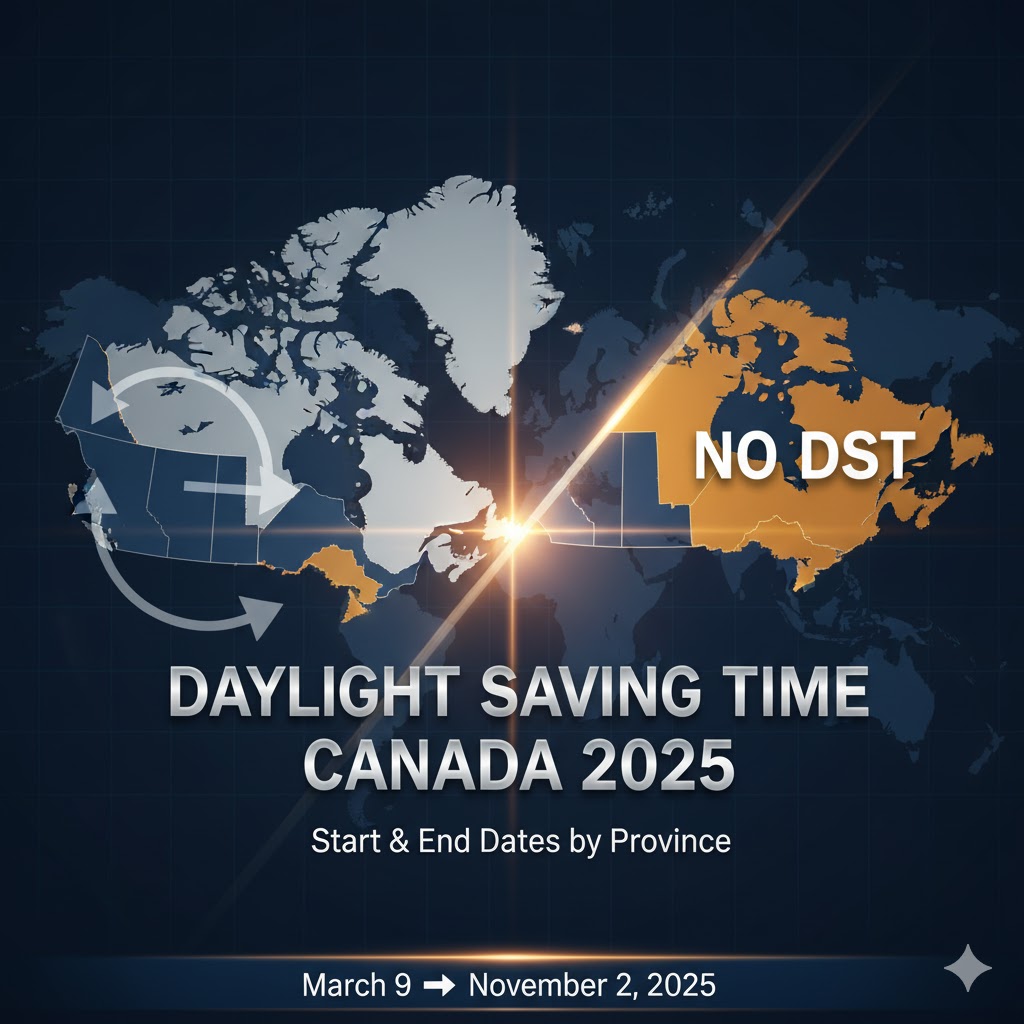
Daylight Saving Time continues to play an important role in Canada’s daily life, balancing energy conservation, productivity, and public convenience. While debates about its future remain active, for 2025 Canadians can expect to “spring forward” on March 9 and “fall back” on November 2 across most provinces.
Understanding local exceptions and adjusting in advance can help prevent confusion, improve rest, and keep schedules aligned — whether you’re traveling, working, or simply enjoying the extra daylight hours that come with this seasonal tradition.
Read More:
- Unforgettable Quebec Winter Carnival 2026 in Canada – World’s Snow Capital
- Ice Magic Festival in Canada 2026 – Winter Wonderland Guide