
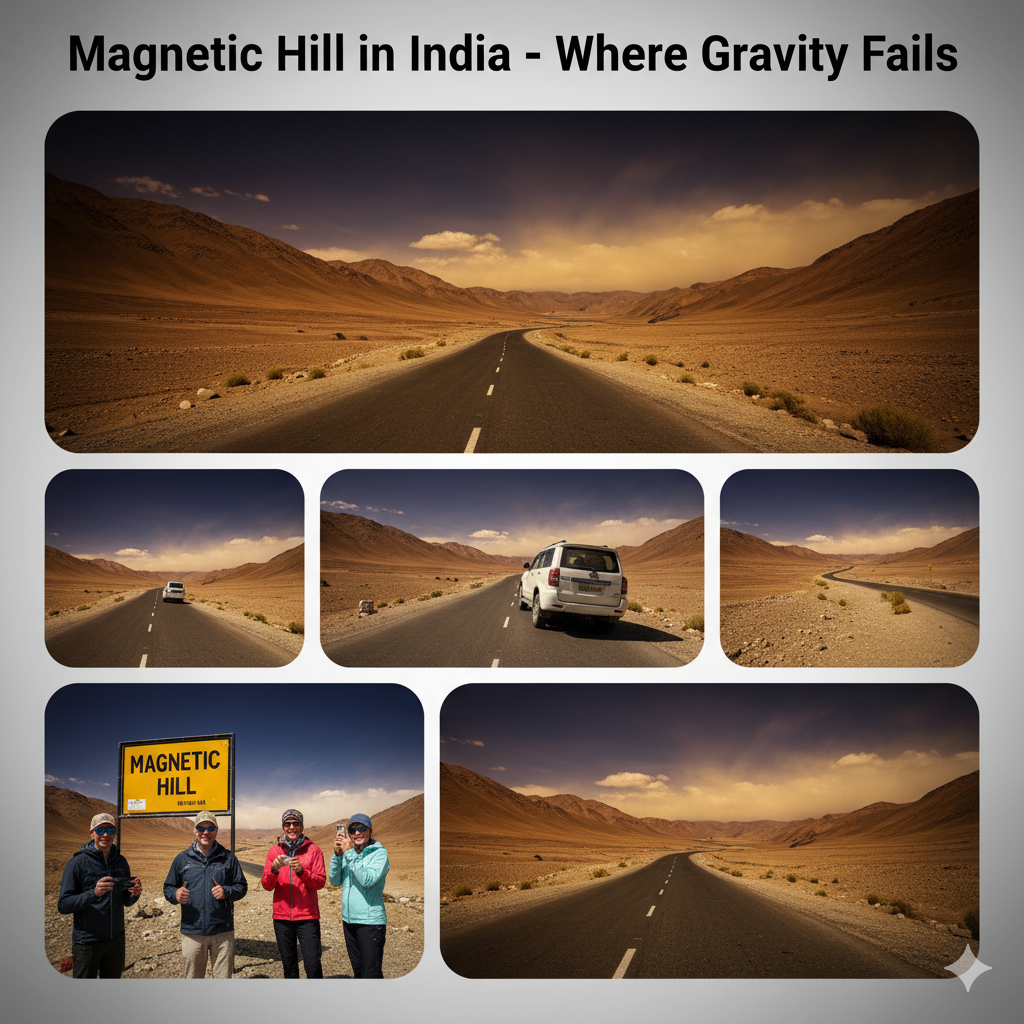

Magnetic Hill India – The Place Where Gravity Fails
Magnetic Hill India is one of those rare places on Earth where your eyes, your senses, and even physics itself seem to betray you.
Located in the high-altitude region of Ladakh, near Leh, this mysterious spot appears to defy gravity — vehicles left out of gear seem to roll uphill on their own, without any engine power.
Tourists from around the world flock here to witness what seems like a miracle of nature. But is it really a magnetic force? Or is it one of the most clever optical illusions on the planet?
In this article, we’ll uncover 10 mind-bending facts about the Magnetic Hill — exploring its science, legends, and the unforgettable experience of visiting India’s “gravity hill.”
Where Exactly Is Magnetic Hill Located?
Magnetic Hill is situated on the Leh–Kargil–Baltic National Highway (NH-1), about 30 kilometers from Leh, in the Ladakh region of northern India.
Coordinates: 33.993°N, 77.036°E
Altitude: Approximately 14,000 feet (4,267 meters) above sea level
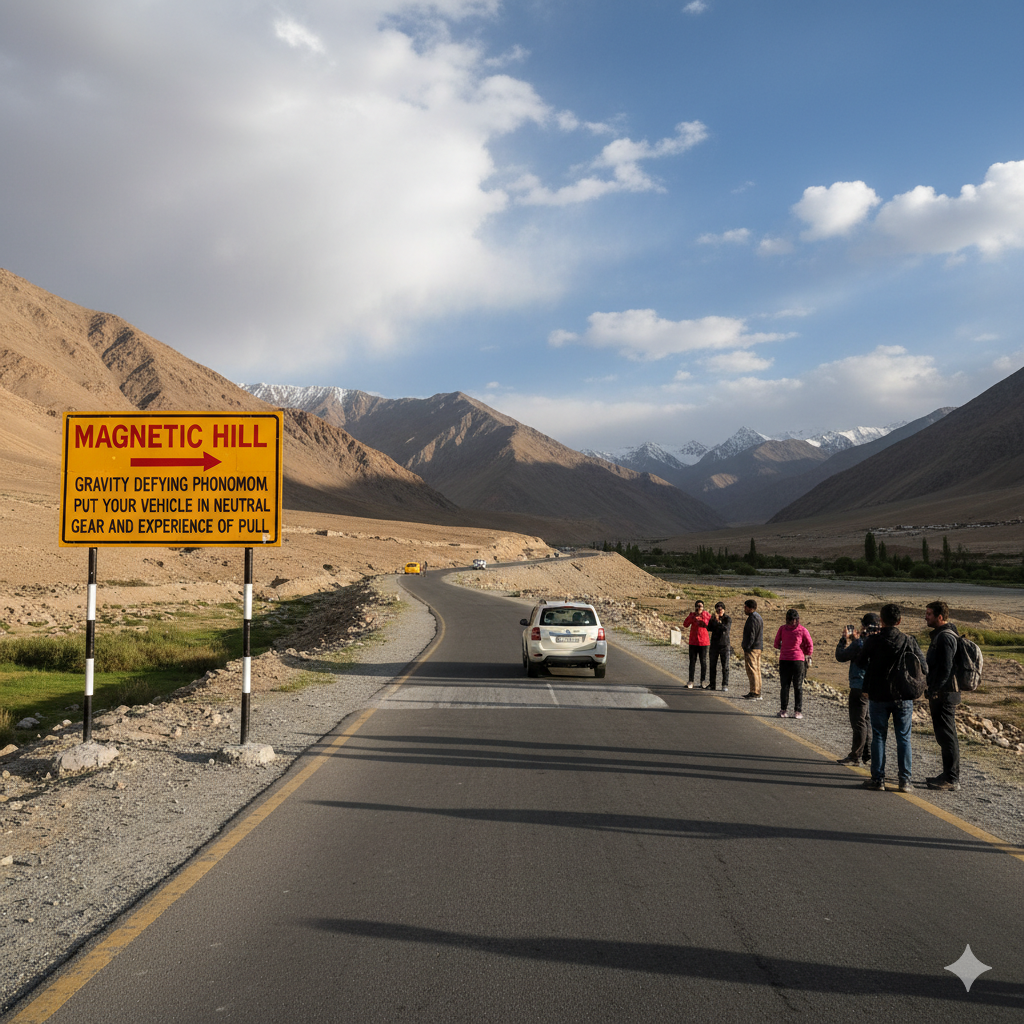
This region lies on the edge of the Himalayan plateau, surrounded by stark, barren mountains that create the perfect stage for one of nature’s strangest illusions.
The Gravity-Defying Phenomenon
At Magnetic Hill, there’s a clearly marked spot on the road with a signboard that reads:
“Park your vehicle in neutral gear and see the magic.”
When you do, something unbelievable happens — the vehicle begins to move uphill seemingly on its own!
Cars, bikes, and even buses appear to roll upward against gravity. Many tourists film this moment, their jaws dropping as their vehicles climb what looks like an incline.
But here’s the twist — it’s not actually defying gravity at all.
The Science Behind the Illusion
The phenomenon of Magnetic Hill is actually a classic optical illusion known as a “gravity hill.”

Here’s what’s happening:
- The layout of the surrounding landscape tricks your brain into perceiving a downhill slope as an uphill slope.
- The horizon line and mountain angles are misaligned.
- As a result, when your car rolls “up,” it’s actually moving downhill, following gravity normally.
Scientists have confirmed that there’s no unusual magnetic force involved — it’s all about visual perception.
Still, the experience feels so real that even skeptics can’t help but feel amazed.
The Magnetic Myth – Legends from Ladakh
Before science explained it, locals had their own theories about Magnetic Hill.
According to Ladakhi folklore, the hill was once believed to be a pathway to heaven. Those worthy would be pulled upward, while sinners would stay grounded.

Another legend suggests that magnetic forces beneath the Earth’s surface were strong enough to pull cars upward — hence the name “Magnetic Hill.”
Even though modern science has debunked these stories, the myths remain an important part of Ladakh’s cultural storytelling.
The Tourist Experience
Visiting Magnetic Hill is one of the highlights of any trip to Leh–Ladakh.
Tourists typically stop at the yellow signboard marking the spot, put their car in neutral, and record the experience.
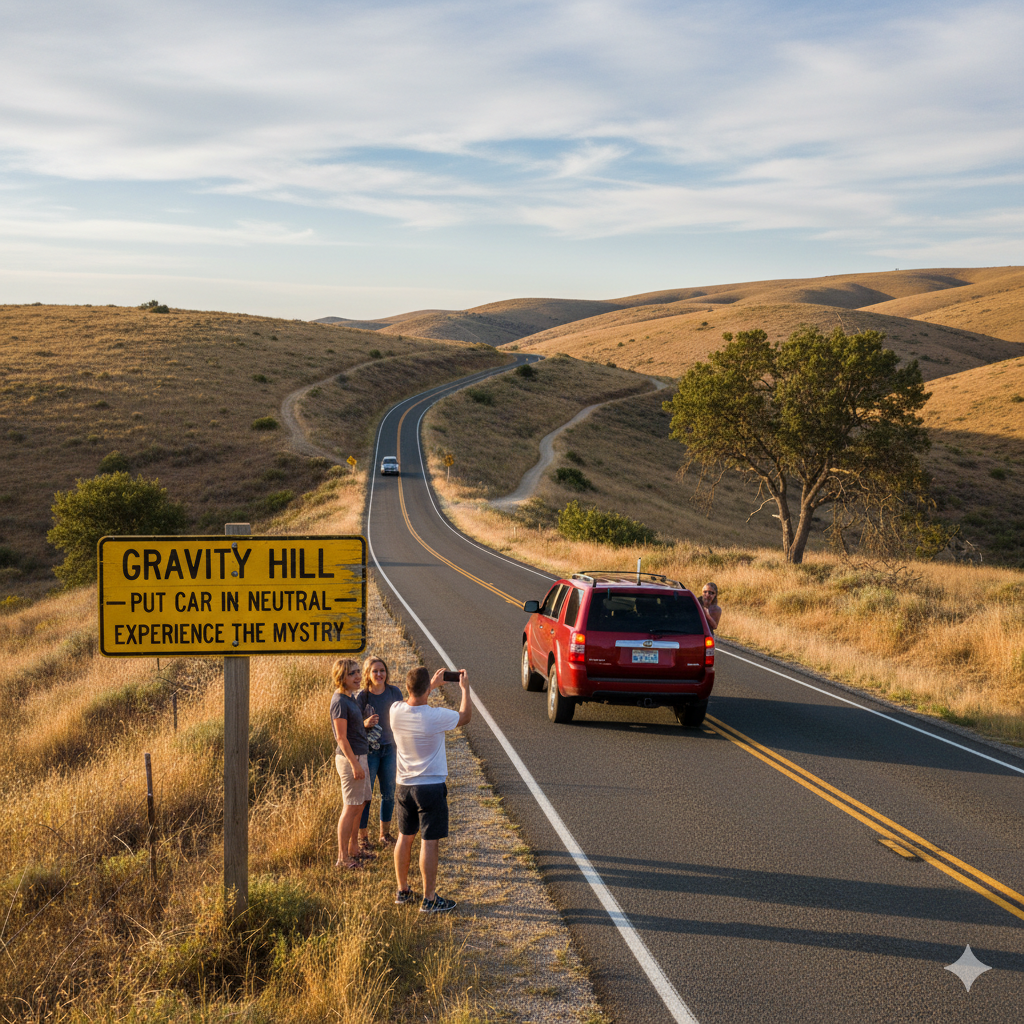
Here’s what most people describe:
- The car slowly starts to move uphill for about 200–300 feet.
- The slope seems visibly upward.
- The entire event lasts about 20–30 seconds.
Even after knowing the science, it’s hard not to feel a sense of wonder at how convincing the illusion is.
Source:
Incredible India – Magnetic Hill Ladakh
BBC Travel – The Hill That Defies Gravity
The Perfect Geographic Setup
The surrounding terrain plays a crucial role in creating this mind-bending illusion.
The area has:
- A mild downward slope of around 4 degrees,
- Slanting mountain ridges on both sides that confuse depth perception,
- And a horizon tilt that tricks the human eye.
These combined elements cause your brain to misinterpret which direction is actually “up” and “down.”
It’s a perfect natural setup for optical trickery — no magnets required!
Other Magnetic Hills Around the World
Magnetic Hill in Ladakh isn’t the only one of its kind.

There are gravity hills all over the world, including:
- Magnetic Hill, Moncton (Canada)
- Electric Brae, Scotland
- Confusion Hill, California (USA)
- Jeju Island’s Mysterious Road (South Korea)
All of these places share the same optical illusion — roads that seem to go uphill but are actually sloped downward.
Still, India’s Magnetic Hill stands out for its dramatic Himalayan backdrop and unique altitude, which amplify the effect.
How to Reach Magnetic Hill
By Air:
The nearest airport is Kushok Bakula Rimpochee Airport (IXL) in Leh — connected to Delhi, Srinagar, and other major cities.
By Road:
From Leh, take the NH-1 Leh–Kargil Highway. Magnetic Hill is a 30-minute drive west of Leh, past the village of Sangam, where the Zanskar and Indus rivers meet.
By Tour:
Most Ladakh road trip packages include Magnetic Hill along with Hall of Fame Museum, Sangam Point, and Gurudwara Pathar Sahib — all within a few kilometers.
Best Time to Visit
The best time to visit Magnetic Hill is between May and October, when the Leh–Ladakh roads are open and weather conditions are ideal.
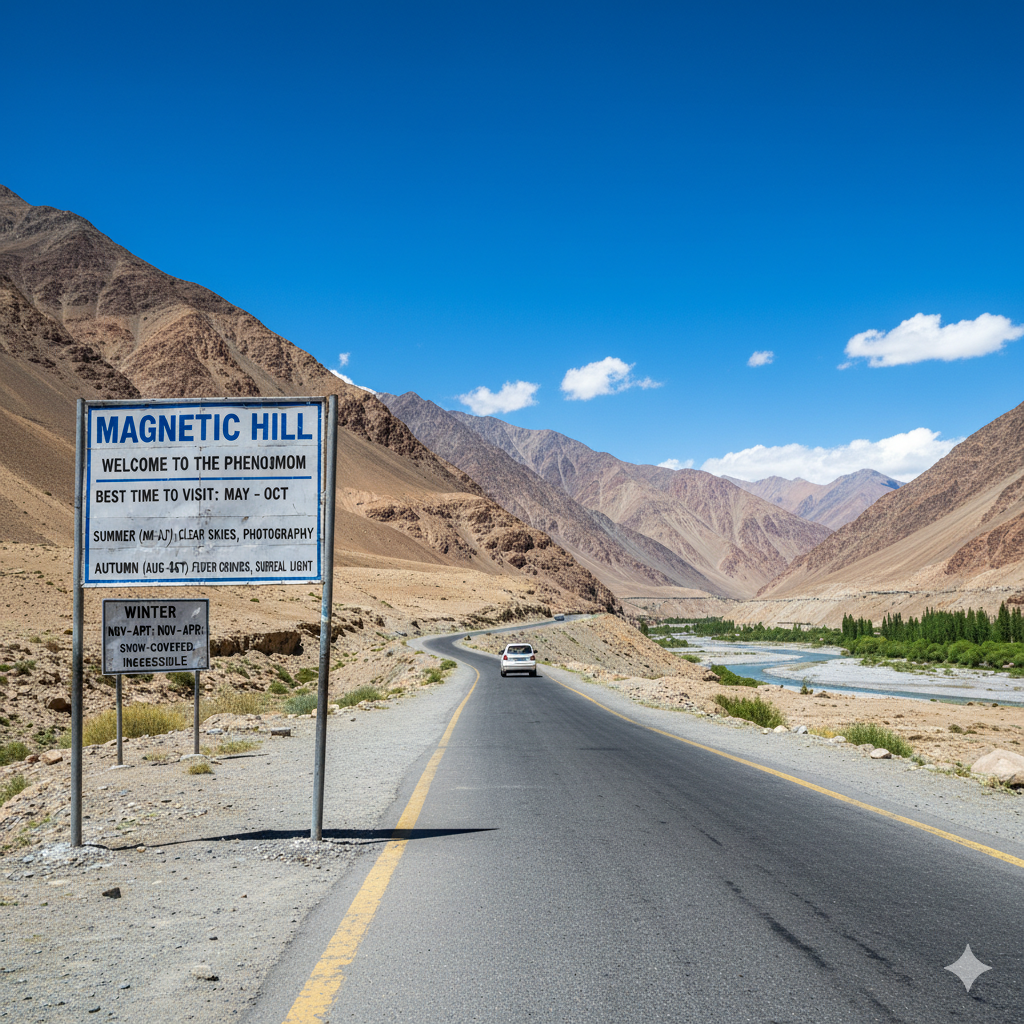
- Summer (May–July): Clear skies, perfect for photography.
- Autumn (August–October): Fewer crowds, surreal lighting for the illusion.
- Winter (Nov–April): The region becomes snow-covered and difficult to access.
Early morning or late afternoon is ideal for photographing the illusion, as shadows are softer and the horizon is more defined.
Travel Tips for Visitors
If you’re planning to visit Magnetic Hill, keep these travel tips in mind:
Always put your vehicle in neutral only at the designated spot.
Keep a safe distance from other vehicles.
Bring sunglasses — the sun glare in Ladakh can distort perception further.
Visit nearby attractions like Gurudwara Pathar Sahib and Sangam Point for a full half-day experience.
Carry water and snacks, as there are limited facilities nearby.
Bonus: Why Your Brain Believes It
The reason Magnetic Hill feels so real is due to how our brains interpret visual cues.
Normally, your brain determines “up” and “down” by referencing the horizon line.
When the horizon is tilted — as it is at Magnetic Hill — your brain is tricked into thinking the slope goes the opposite way.

This powerful illusion overrides your rational understanding, making you feel as though gravity has stopped working.
Check Also: Top 10 World Deepest Cave – Nature’s Hidden Abyss
FAQs
1. Is Magnetic Hill really magnetic?
No — it’s an optical illusion caused by the layout of the surrounding landscape.
2. Where is Magnetic Hill located?
It’s near Leh, in Ladakh, on the Leh–Kargil highway.
3. Can you visit Magnetic Hill all year round?
No, it’s best to visit between May and October when roads are open.
4. How do vehicles move uphill?
They actually move downhill due to gravity — the slope only appears upward because of a distorted horizon line.
5. Are there other magnetic hills in India?
While Ladakh’s is the most famous, similar optical illusions exist near Tawang (Arunachal Pradesh) and near Shillong (Meghalaya).
Traveler: Where Science Meets Magic
The Magnetic Hill in India is a perfect example of how our eyes can deceive us — and how nature can still leave us in awe, even when the explanation is simple.
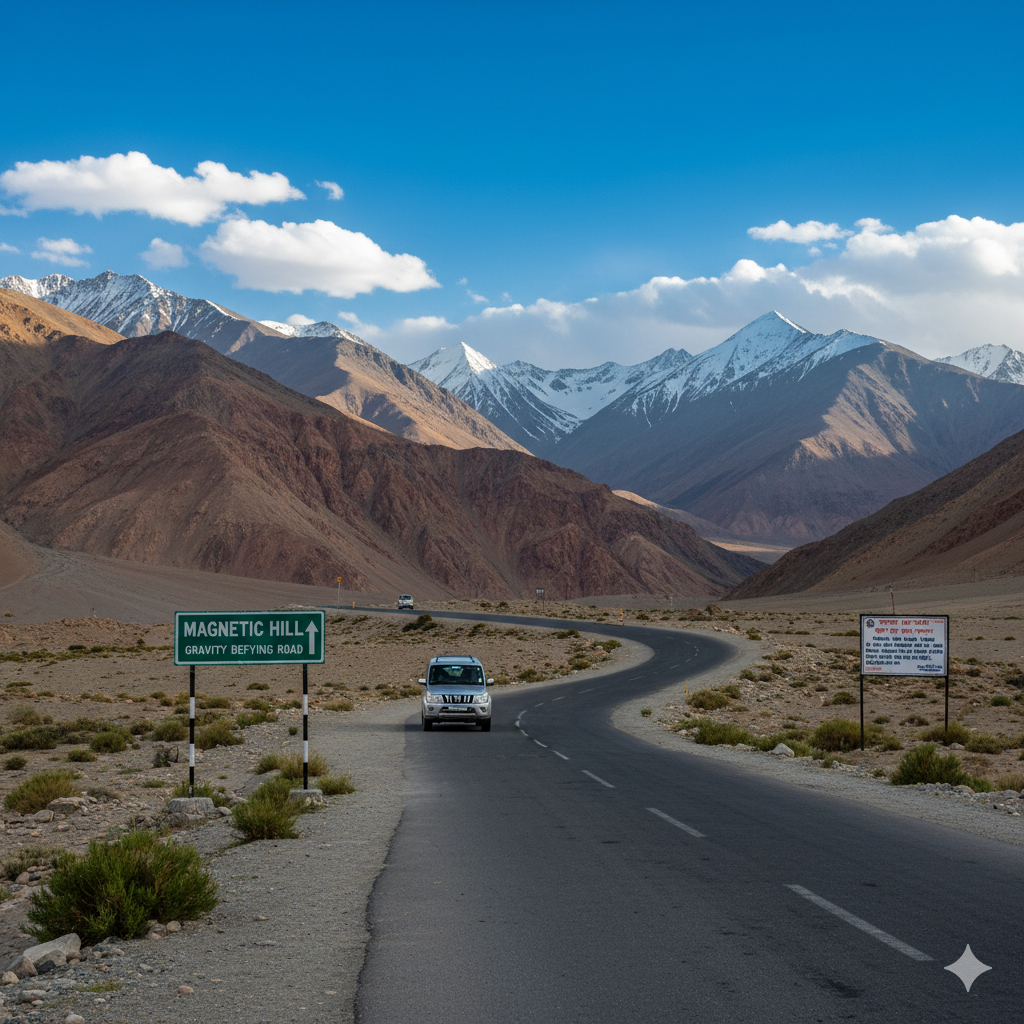
Whether you believe in the myths or the science, standing there as your car “climbs” uphill feels like witnessing magic.
It’s not just a place — it’s an experience that reminds us that the world is full of wonders hiding in plain sight.
So the next time you visit Ladakh, don’t miss this unforgettable stop on your journey through the Himalayas — where gravity fails, and curiosity wins.