

Introduction — Pakistan’s Higher Education Steps Into 2026
Pakistan University Admissions 2026 mark a groundbreaking shift in how students across the country will apply, qualify, and secure seats in public and private universities. The Higher Education Commission (HEC) has introduced digital reforms, standardized merit systems, and transparent quotas to make the process more accessible and fair for all applicants.
From unified portals to verified transcripts, the 2026 admission framework aims to make Pakistan’s higher education system globally aligned and technologically advanced — ensuring every student gets a fair opportunity to succeed.
As 2026 begins, Pakistan’s higher education system stands at the edge of a transformative new era.
The Higher Education Commission (HEC) and provincial universities have launched sweeping reforms to make admissions more transparent, equitable, and technology-driven.
From revamped merit formulas to digital admission systems and updated quotas, the 2026 admission cycle aims to simplify access while aligning university programs with global academic standards.
Whether you’re applying for BS, MPhil, or PhD programs, this comprehensive guide explains everything you need to know about the Pakistan University Admissions Policy 2026.

📘 1. Why the Policy Was Updated in 2026
The HEC’s Higher Education Reform Agenda 2026 was launched after analyzing previous challenges in student enrollment, testing irregularities, and administrative inefficiencies.
Key goals of the reform:
- Eliminate manual paperwork and in-person admissions chaos.
- Introduce a uniform merit formula across provinces.
- Prevent fraudulent transcripts and duplicate entries.
- Encourage digital literacy and accessibility for rural students.
“Our 2026 admissions policy emphasizes equity, innovation, and digital transformation in higher education,”
— Dr. Mukhtar Ahmed, HEC Chairperson.

🧩 2. Major Changes in University Admissions Policy 2026
✅ 1. National Online Admission Portal (NOAP)
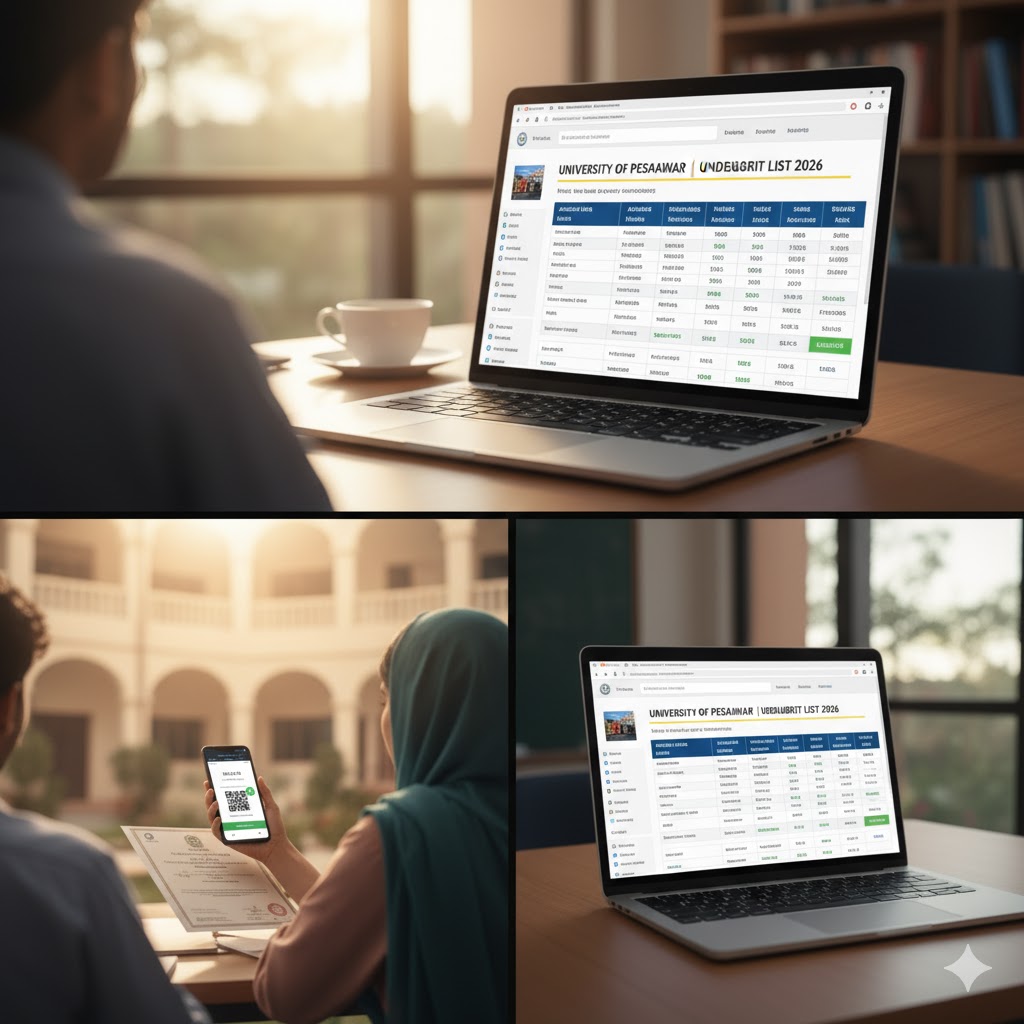
All public universities are now connected through the HEC National Online Admission Portal, found at:
🔗 https://admissions.hec.gov.pk
Through this single system, students can:
- Apply to multiple universities in one dashboard.
- Upload verified documents digitally.
- Track status in real-time.
- Pay admission fees via secure online gateways.
The portal officially replaced manual forms and university-specific portals from 2025 onward.
✅ 2. Revised Merit and Eligibility Criteria
HEC introduced a standardized merit formula for all undergraduate and postgraduate programs.
| Degree Level | Minimum Academic % | Additional Requirements |
|---|---|---|
| BS Programs | 50% in Intermediate | Must pass university/HEC test |
| MPhil/MS | 60% in Bachelor | GAT / internal test required |
| PhD | 70% in MPhil/MS | Research synopsis submission |
This national standard ensures parity across all HEC-recognized institutions.
✅ 3. Unified Admission Test System
From 2026, every university admission test must be conducted by one of the three HEC-approved bodies:
- Education Testing Council (ETC-HEC)
- SIBA Testing Services (STS)
- National Testing Service (NTS)
These centralized testing agencies ensure uniform standards and digital score reporting directly to universities.
✅ 4. Quota Reforms for 2026
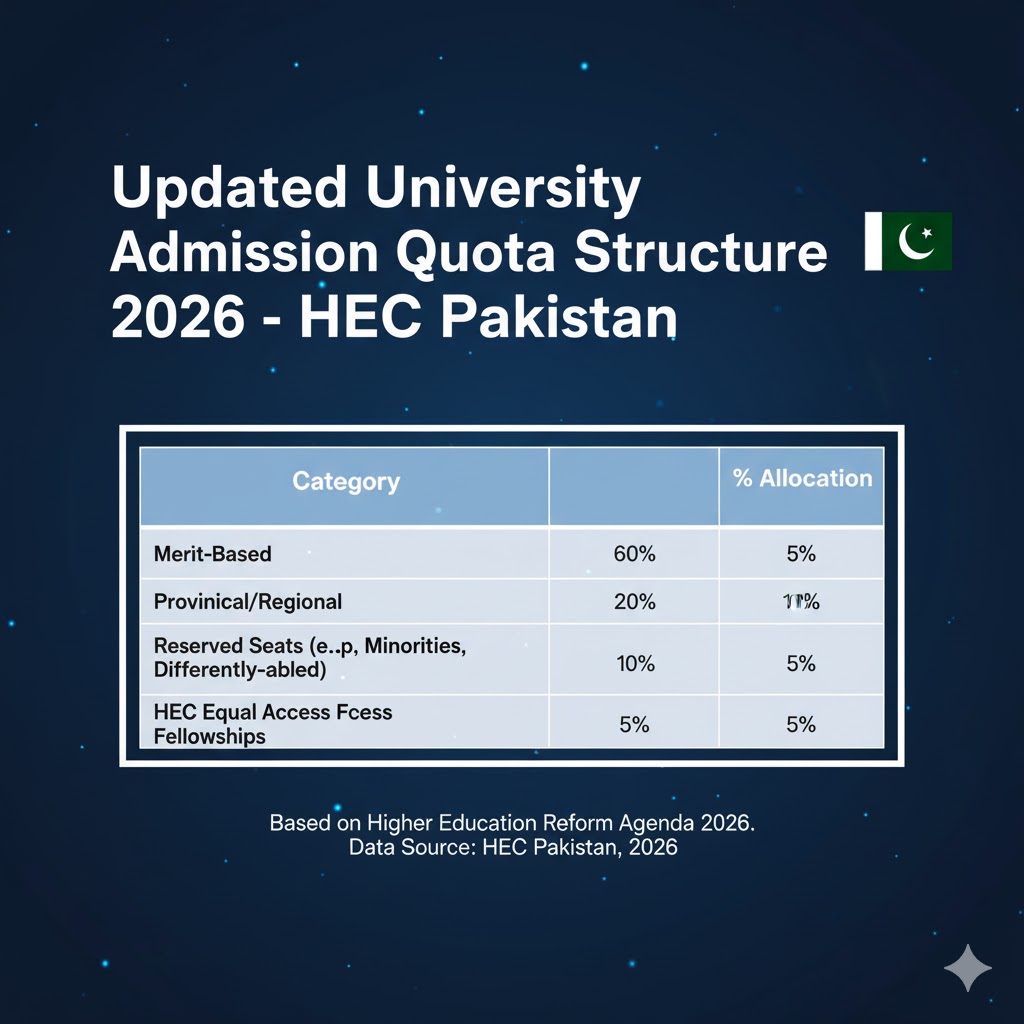
The quota system has been slightly revised to improve inclusivity and fairness:
| Quota Type | Allocation |
|---|---|
| Open Merit | 65% |
| Provincial/Regional | 15% |
| FATA & Gilgit-Baltistan | 5% |
| Overseas Pakistanis | 10% |
| Minority & Disability | 5% |
The increase in the overseas quota aligns with the HEC’s global partnership drive, encouraging expat families to contribute to national education.
✅ 5. Credit Transfer & Recognition System (CTRS)
The National Credit Transfer Framework (2026) now allows students to:
- Transfer credits between HEC-accredited universities.
- Count MOOCs and certified online courses toward degree requirements.
- Access digital transcript verification through blockchain-backed records.
This change makes Pakistan’s higher education system globally compatible with institutions in Europe and Southeast Asia.
✅ 6. Fee Regulation Framework – Admissions Policy 2026
A Tuition Oversight Board (TOB) has been formed to:
- Limit annual fee increases to 10% maximum.
- Require universities to post detailed fee charts online.
- Ban “hidden” surcharges in admission slips.
Private universities now face annual audits to maintain transparency in student billing.

✅ 7. New Scholarship and Financial Aid Rules
HEC and provincial governments jointly launched the Merit + Need Scholarship Scheme 2026:
- Covers up to 100% tuition fee for top 5% of each board.
- Introduces special grants for female STEM students.
- Expands Ehsaas Undergraduate Scholarship funding by 20%.
Applications are integrated directly into the NOAP portal, simplifying access.
✅ 8. Digital Verification via HEC DFVS
All academic documents must be validated online before submission through the HEC Document & Fee Verification System (DFVS):
🔗 https://hec.gov.pk/dfvs
Unverified credentials will automatically disqualify applicants during digital audit.

🏛️ 3. HEC’s Monitoring & Accountability Measures
The HEC has increased oversight in 2026 with the following mechanisms:
- Digital enrollment tracking per semester.
- Automated merit list verification by AI.
- Real-time reporting of admission statistics to provincial boards.
- Compulsory publishing of 1st, 2nd, and 3rd merit lists online.
The system ensures that no seat remains unaccounted for, preventing manipulation or favoritism.
💬 4. Reactions from Students and Faculty
The reforms received a strong positive response from both educators and students.
“Applying online through a single national portal was life-changing — no queues, no travel,”
says Maha Ali, an intermediate graduate from Multan.
Faculty members, however, cautioned that smaller universities will need better IT infrastructure to keep up with digitization.
HEC confirmed it will provide cloud support and training to all participating institutions before June 2026.
🧠 5. Challenges to Watch – Admissions Policy 2026
The 2026 policy rollout still faces practical hurdles:
- Internet connectivity gaps in Balochistan and interior Sindh.
- Limited awareness of credit-transfer options.
- Institutional delays in integrating systems.
To address this, HEC has partnered with NADRA and PTA to enable offline verification through mobile kiosks in underserved areas.

🌍 6. International Alignment & Recognition
The 2026 admission framework positions Pakistan closer to international standards by aligning credit and testing systems with the Bologna Process and Washington Accord.
HEC’s digital credentialing model is also being recognized by QS Rankings for improving transparency — a key factor in boosting Pakistan’s global university standing.
📚 7. Key Benefits – Admissions Policy 2026
- Apply to 20+ universities using one profile.
- Monitor merit list progress in real time.
- Use verified digital credentials instead of paper documents.
- Transfer credits between institutions seamlessly.
- Benefit from expanded scholarships and quotas.
By removing red tape, the 2026 policy ensures that merit, not paperwork, determines success.

FAQs — Pakistan University Admissions 2026
Q1: When will admissions open for 2026?
Most universities begin accepting applications from April through August 2026, depending on the province.
Q2: Is the online admission portal mandatory?
Yes, for all public-sector universities registered with HEC. Private universities may join voluntarily.
Q3: Are the quota percentages the same nationwide?
Yes, but autonomous universities may reserve up to 5% for special programs or research grants.
Q4: How do I verify my intermediate result before applying?
Through the HEC DFVS system or your board’s integrated verification module.
Q5: Can overseas Pakistanis apply directly?
Yes — via the Overseas Students Division in the same portal using scanned verified credentials.

References: Pakistan University Admissions 2026
Must See:
Sources:
- Higher Education Commission (HEC) Official Site
- Ministry of Federal Education & Professional Training
- Dawn Education Reports 2026
Mentors Guide — Education in Pakistan Enters the Digital Decade
The Pakistan University Admissions Policy 2026 marks a turning point for higher education.
By merging technology, transparency, and inclusivity, it eliminates decades of inefficiency and levels the playing field for every student — urban or rural.
While implementation challenges remain, Pakistan’s universities are now better connected, more accountable, and globally aligned than ever before.
“Education reform isn’t just about access — it’s about building a fair system where merit meets opportunity.” — HEC Policy Report 2026


