
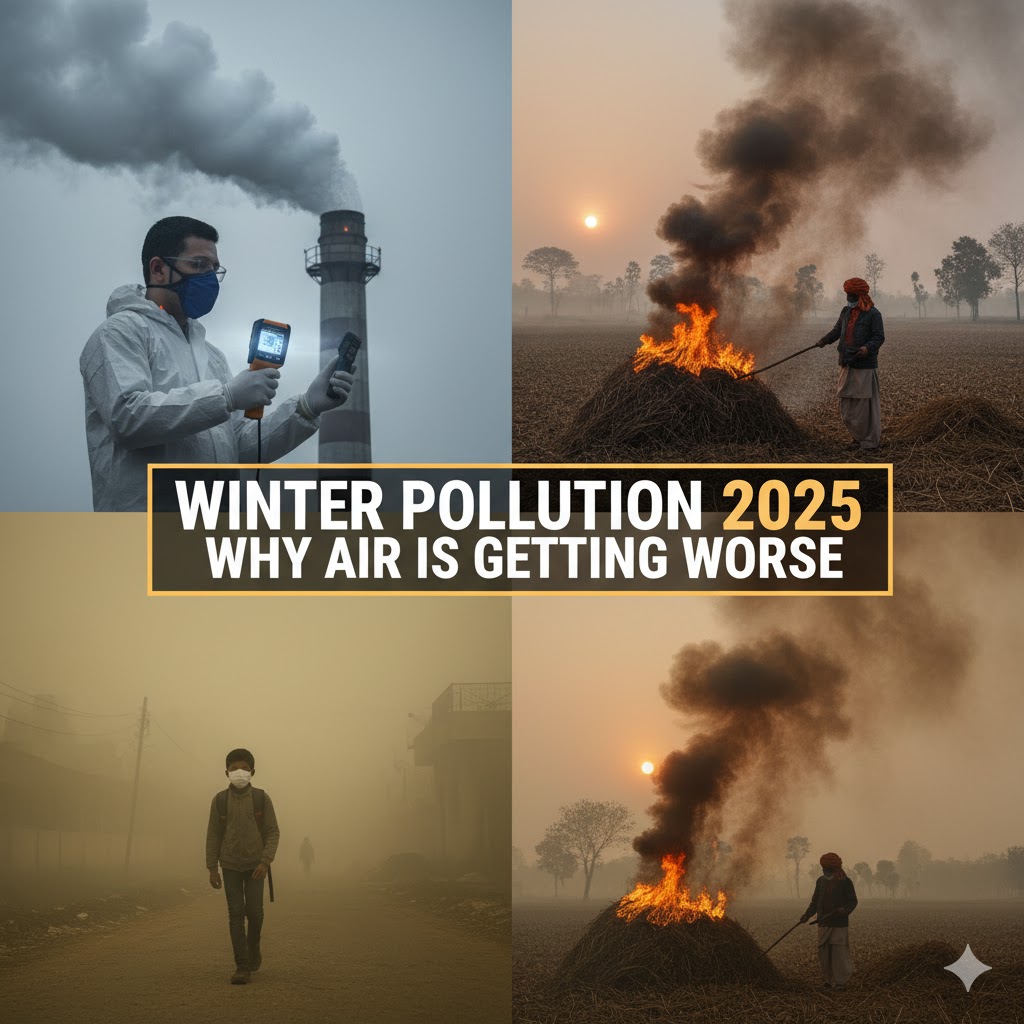

Pakistan Winter Pollution 2025 — A Growing Environmental Challenge
Winter Pakistan pollution Air Quality 2025 marks yet another critical season for the country’s air quality.
As temperatures drop, the Air Quality Index (AQI) in several major cities — especially Lahore, Faisalabad, Gujranwala, and Karachi — has reached hazardous levels.
The winter months (October–January) trap pollutants due to cold inversions, low wind movement, and ongoing urban emissions, creating thick layers of smog that threaten public health and visibility.
The situation in Punjab and Sindh mirrors environmental emergencies across South Asia, demanding urgent attention and public awareness.

What Causes Pakistan’s Winter Smog Crisis
Experts identify multiple contributors behind Pakistan’s recurring pollution spikes:
- 🚗 Vehicle Emissions: Outdated vehicles and diesel engines emit heavy particulate matter (PM2.5).
- 🏭 Industrial Smoke: Brick kilns, factories, and unregulated industrial zones burn low-grade fuels.
- 🌾 Crop Residue Burning: Post-harvest stubble burning in Punjab and Haryana adds massive smoke layers.
- 🔥 Domestic Heating: In colder months, many homes burn coal or wood, intensifying urban pollution.
- 🧱 Construction Dust: Large infrastructure projects continue year-round without dust-control measures.
The combination of these sources under winter weather conditions forms a toxic smog blanket that often lasts for weeks.

📈 Air Quality Index (AQI) Levels Across Major Cities — Winter 2025
| City | PM2.5 Level (µg/m³) | AQI Reading | Category |
|---|---|---|---|
| Lahore | 267 | 385 | Hazardous |
| Faisalabad | 198 | 322 | Very Unhealthy |
| Karachi | 141 | 215 | Unhealthy |
| Islamabad | 118 | 185 | Unhealthy for Sensitive Groups |
| Multan | 165 | 255 | Very Unhealthy |
(Source: Air Quality Data, Pakistan Meteorological Department & IQAir, November 2025)
Lahore remains the most polluted city, frequently topping global AQI charts, while smaller cities like Okara and Kasur also record severe readings due to proximity to agricultural zones.

🧪 Health Impacts of Winter Air Pollution
The dense smog of winter 2025 is not just a visibility issue — it’s a public health emergency.
Common Health Effects:
- Chronic cough, sore throat, and eye irritation
- Shortness of breath and asthma attacks
- Lung infections and bronchitis
- Long-term heart and respiratory complications
Medical experts report a 20–30% increase in respiratory OPD visits in Lahore and Faisalabad during peak smog days.
Children, the elderly, and outdoor workers are at highest risk.
“Smog exposure is equivalent to smoking 10 cigarettes a day in Lahore’s worst conditions,”
— Dr. Adeel Rana, Pulmonologist, Mayo Hospital Lahore.

🧠 Why Pollution Gets Worse in Winter
Winter months intensify air pollution due to a meteorological process known as temperature inversion.
Normally, warm air rises and disperses pollutants. But in winter, a layer of cold air traps the polluted air near the ground.
Combined with lower wind speeds and fog-like humidity, this forms persistent smog clouds, especially in low-lying areas like Punjab’s plains.
🏙️ Government and HEC Initiatives Against Smog 2025
The Government of Punjab and Ministry of Climate Change (MoCC) have launched new regulatory and educational programs to combat smog:
- 🌳 Smog War Room 2.0: A central digital dashboard monitoring real-time AQI and emissions.
- 🚫 Brick Kiln Conversion Program: 80% of kilns now using zigzag technology to reduce smoke.
- 🌾 Crop Residue Management Grants: Financial support for farmers to buy no-burn shredders.
- 🧑🏫 University Awareness Drives: HEC mandates environment-awareness workshops in major universities.
- 🚙 Vehicle Inspection Stations: Random roadside emissions testing started in Lahore and Faisalabad.

🧤 How to Protect Yourself from Smog in Winter 2025
Here are practical tips to reduce health risks during smog-heavy days:
✅ Use N95 Masks when going outdoors.
✅ Keep indoor air clean using air purifiers or wet mopping.
✅ Avoid early morning walks (peak pollution hours).
✅ Drink more fluids to flush toxins from the body.
✅ Monitor AQI daily through apps like IQAir or AccuWeather.
✅ Stay indoors when AQI exceeds 300 (hazardous).

🌱 Long-Term Solutions for Pakistan’s Air Quality
Environmental experts propose a 5-year roadmap to fight winter pollution:
- Shift urban transport to electric vehicles.
- Enforce industrial emission caps through digital sensors.
- Expand tree plantation belts along highways and city borders.
- Develop eco-friendly heating systems for rural homes.
- Launch public awareness campaigns in schools and universities.
Pakistan’s adoption of the Clean Air Act 2025 shows national commitment, but success will depend on consistent enforcement and citizen participation.

FAQs — Pakistan Winter Pollution 2025
Q1: Why does Pakistan experience heavy smog in winter?
Due to temperature inversion, industrial emissions, and stubble burning, pollutants get trapped near the surface.
Q2: Which city is most affected by smog?
Lahore consistently records the highest AQI, often reaching “hazardous” levels.
Q3: What precautions can students and workers take?
Wear N95 masks, avoid peak traffic hours, and keep classrooms/rooms ventilated with clean air filters.
Q4: How can citizens track air quality?
Use online platforms like IQAir or the Pakistan EPA’s AQI app.
Q5: What is the government doing to reduce smog?
Implementing industrial emission limits, promoting electric vehicles, and subsidizing clean farming equipment.

References:
Read More:
- Punjab School Timings & Air Quality Report 2025
- Shocking Decision University of Peshawar Closes Program 9 Shuts
Sources:
- Pakistan Environmental Protection Agency (Pak-EPA)
- HEC Climate Awareness Program
- IQAir Global Air Quality Report 2025
Mentor Guide — Breathing Toward a Cleaner Future
The Pakistan Winter Pollution 2025 crisis highlights an uncomfortable truth — air pollution is no longer a seasonal issue, it’s a year-round challenge demanding national unity.
From government policies to citizen habits, every small change counts.
Cleaner technologies, awareness, and enforcement can transform Pakistan’s smog-stricken winters into clearer, healthier seasons for future generations.
“The air we breathe connects us all — protecting it must be our shared responsibility.” — Ministry of Climate Change, 2025