
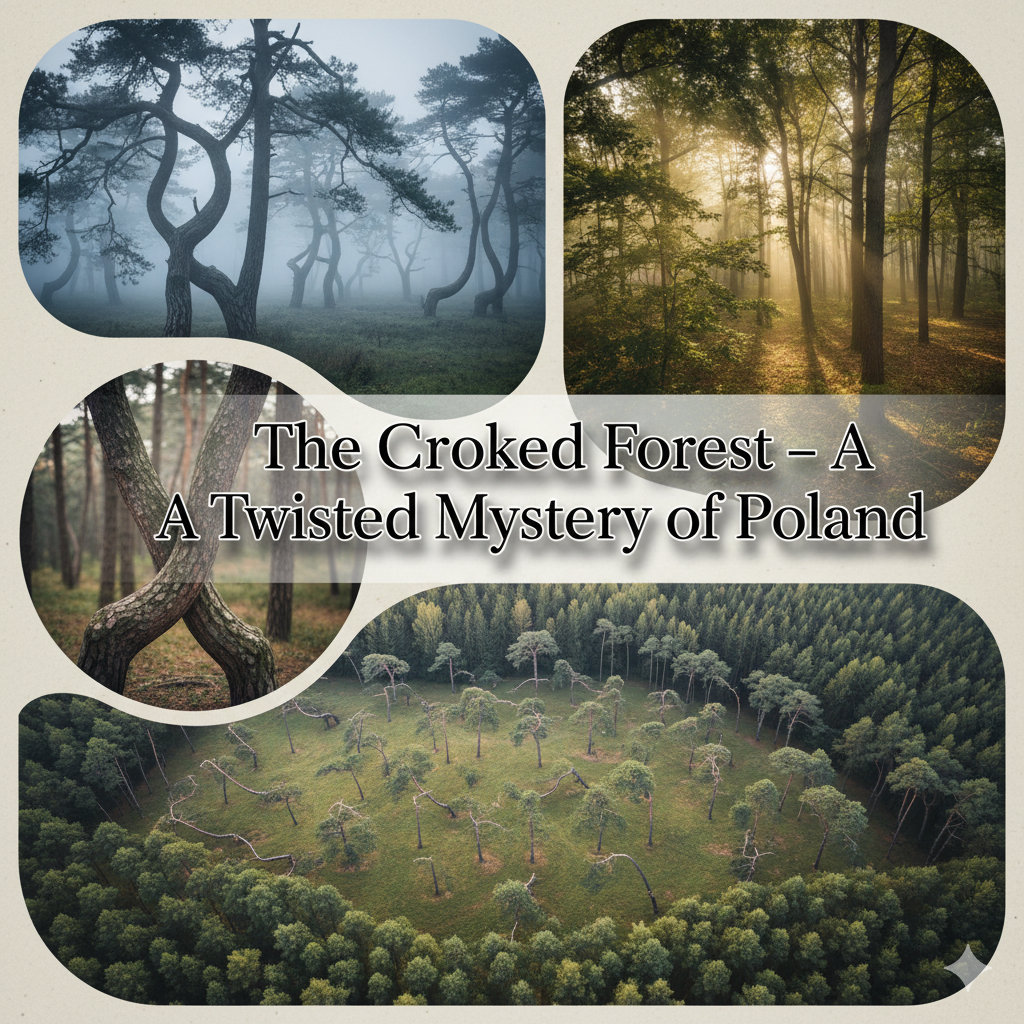

Nature’s Enigma in the Heart of Poland
Deep in the West Pomerania region of Poland, near the small village of Gryfino, lies a woodland that defies all logic and science — a place where hundreds of pine trees grow with a perfect 90-degree bend at their base, as if shaped by some mysterious hand.
This is The Crooked Forest (Krzywy Las) — one of the most unusual natural wonders in Europe, and arguably, one of the greatest botanical mysteries in the world.
Scientists, historians, and tourists have all been fascinated by its unnatural beauty — each tree curved in the same northern direction before straightening skyward like a dancer mid-spin. But why do they grow this way? No one knows for sure.

In this journey, we’ll explore the origins, theories, and cultural impact of Poland’s Crooked Forest, revealing how nature — and perhaps human history — combined to create this twisted masterpiece.
Where is the Crooked Forest Located?
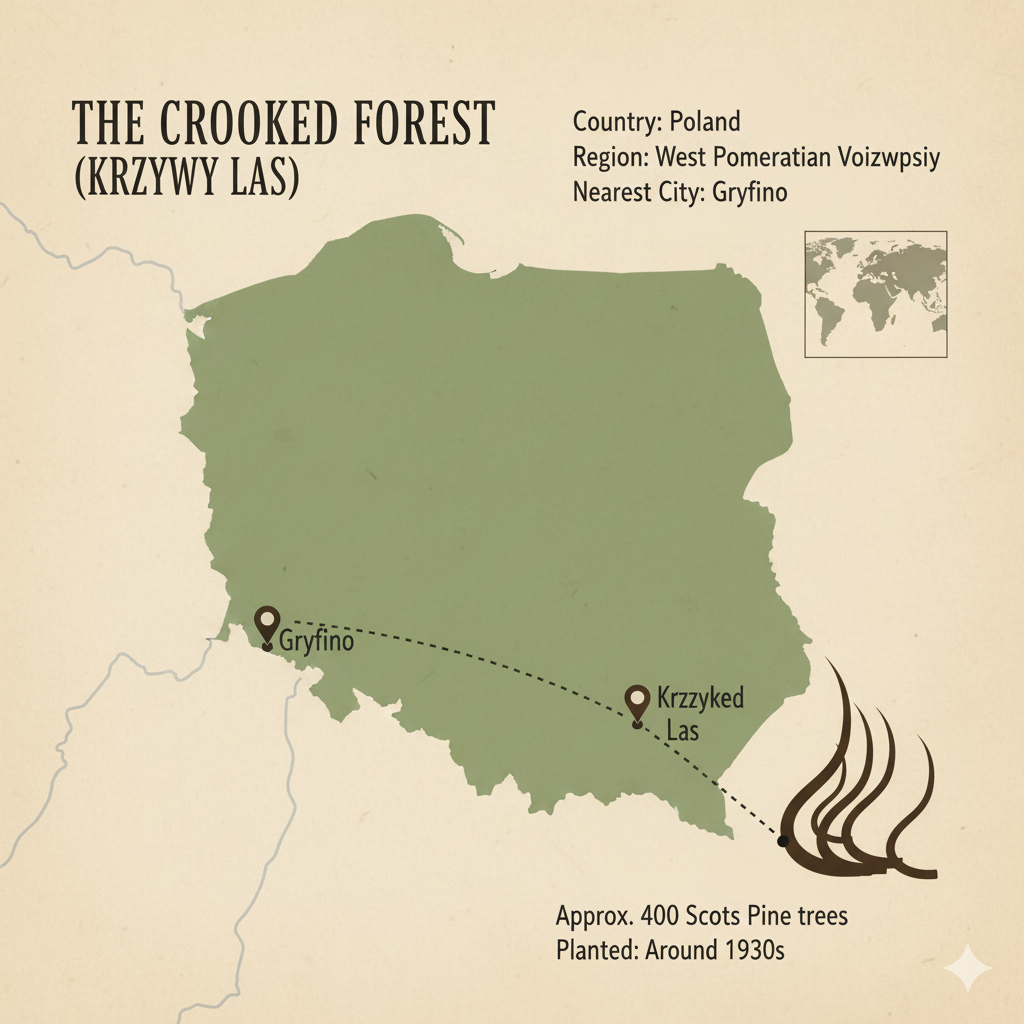
The Crooked Forest (Polish: Krzywy Las) lies just outside Gryfino, a small town in northwestern Poland, about 30 kilometers south of Szczecin and close to the German border.
Quick Facts:
- Country: Poland
- Region: West Pomeranian Voivodeship
- Nearest City: Gryfino
- Tree Count: Approx. 400
- Species: Scots Pine (Pinus sylvestris)
- Planted: Around 1930
Hidden in a quiet corner of Europe, this forest has become one of Poland’s most iconic natural attractions, drawing thousands of visitors, photographers, and nature lovers each year.
What Makes the Crooked Forest So Unique?
At first glance, it looks like an artist’s surreal sculpture park.
But these trees are real and alive — roughly 80–90 years old.
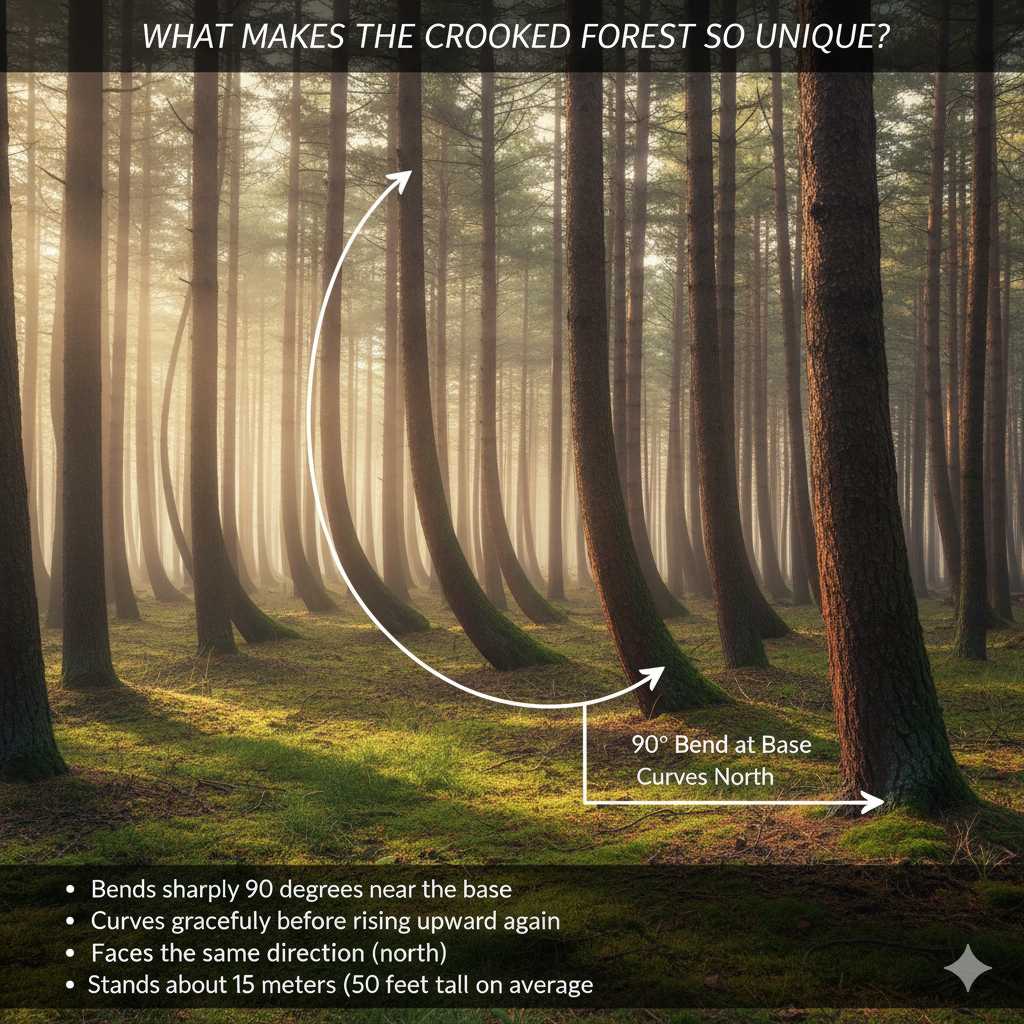
Each pine tree in the forest:
- Bends sharply 90 degrees near the base,
- Curves gracefully before rising upward again,
- Faces the same direction (north),
- And stands about 15 meters (50 feet) tall on average.
The phenomenon is natural yet unnatural, blending biology with mystery.
Unlike trees deformed by storms or soil movement, the Crooked Forest’s bends are uniform and intentional-looking — suggesting human influence… or something else entirely.
The History Behind the Crooked Forest
Most experts agree that the Crooked Forest was planted around 1930, when the region was part of Germany (then called Pomerania).
During this time, the area was reforested for timber production. The pine trees grew normally for a few years — until something altered their growth patterns dramatically.
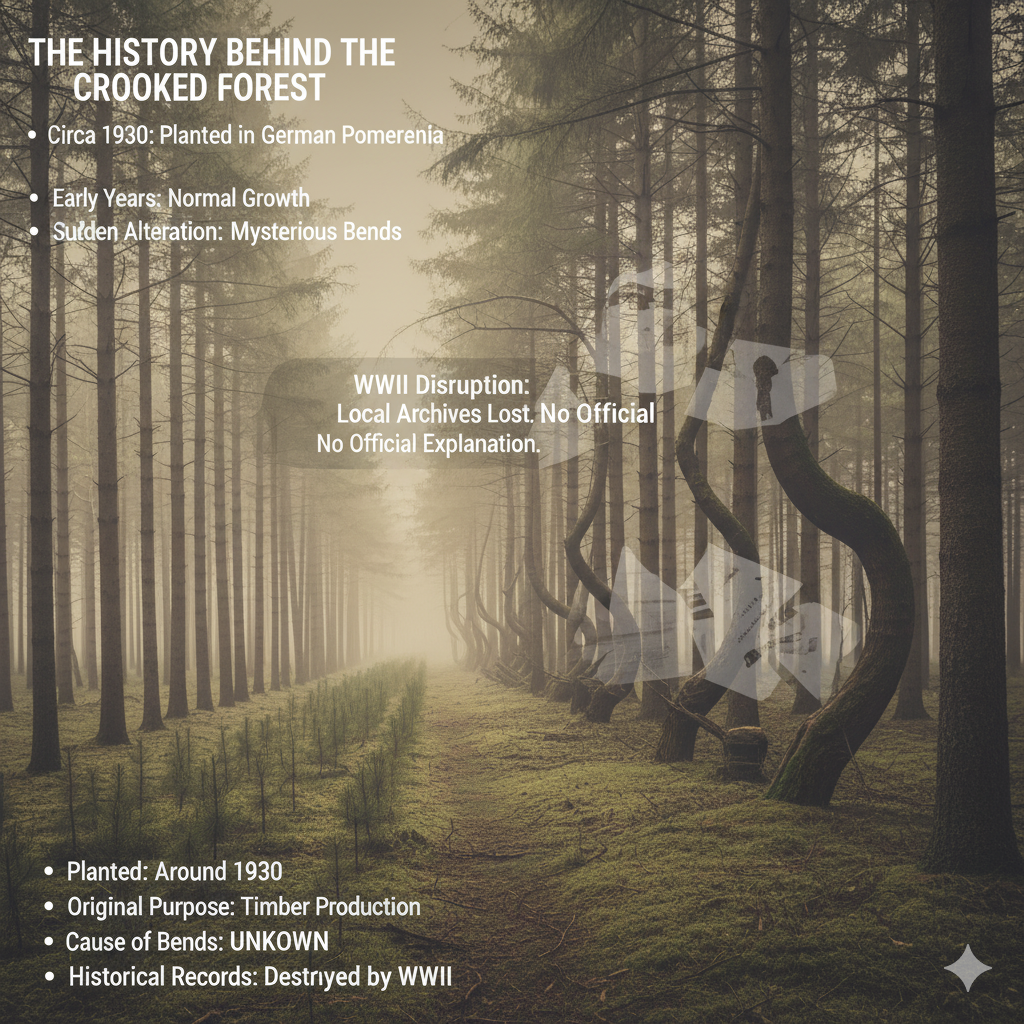
However, historical records from World War II disrupted local archives, leaving no official explanation for the forest’s bizarre shape.
Today, only legends and scientific theories remain.
The Top Theories Explaining the Mystery
The Crooked Forest has inspired decades of debate.
Here are the most popular theories that attempt to explain it:
Theory 1: Human Intervention (Wood-Shaping Technique)
The most widely accepted idea is that humans intentionally shaped these trees during their early years (around 7–10 years old).
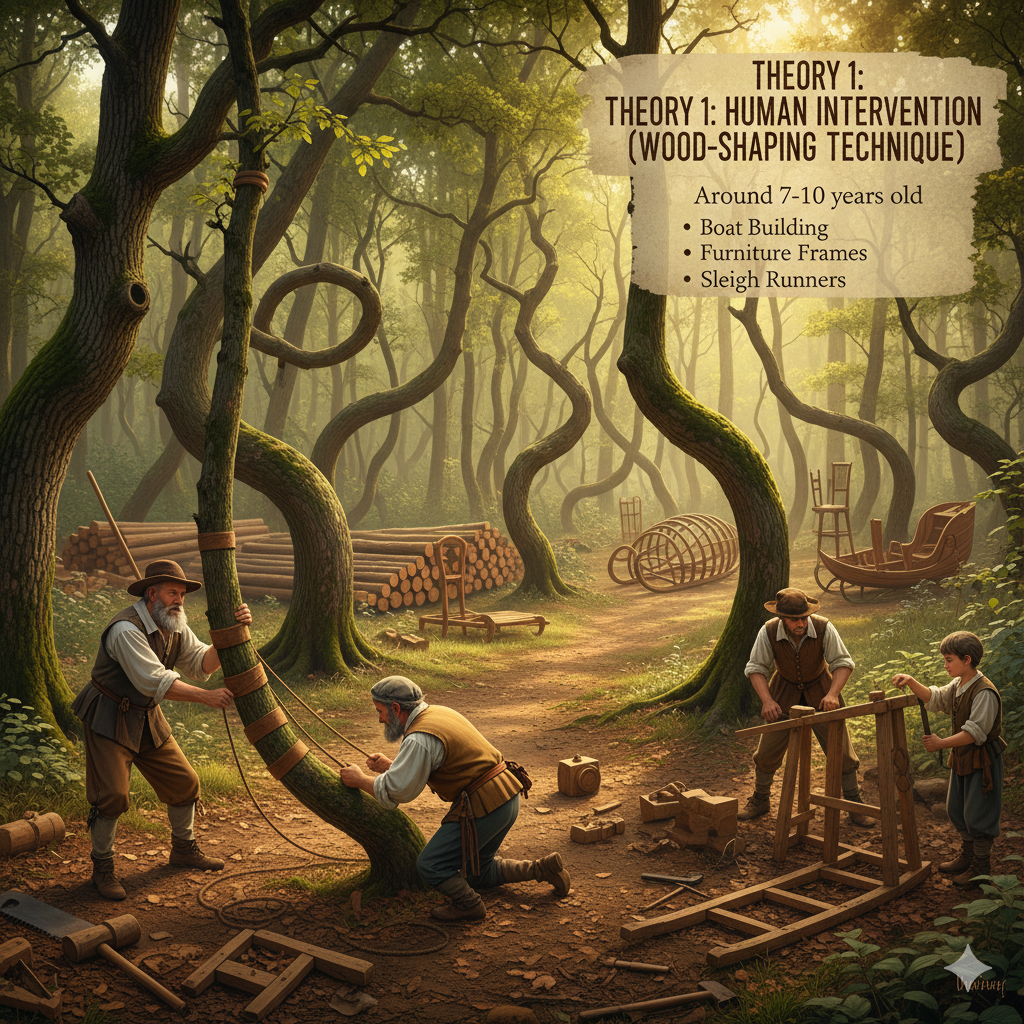
Farmers or carpenters might have bent the trunks to create naturally curved timber — perfect for:
- Boat building,
- Furniture frames, or
- Sleigh runners.
However, World War II interrupted the project, leaving the trees to continue growing normally after the shaping phase.
This theory makes practical sense, especially since timber shaping was common in early 20th-century Europe.
Theory 2: Heavy Snow or Ice Damage
Some scientists propose that a snowstorm or ice weight pressed the saplings to the ground during winter, causing the base to curve permanently.
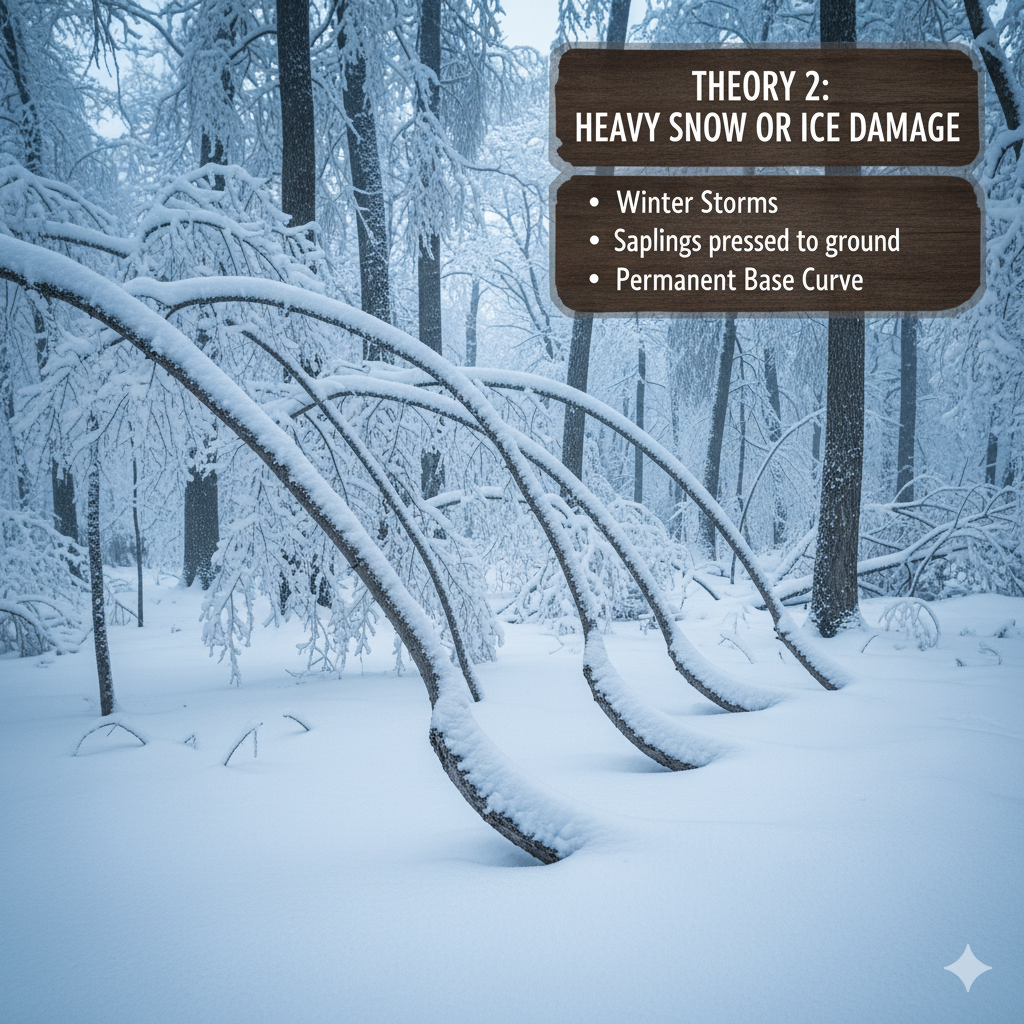
But the uniform direction and shape of every tree make this unlikely — natural events rarely produce such consistent patterns.
Theory 3: Magnetic Field Distortion
Another intriguing idea involves gravitational or geomagnetic anomalies.
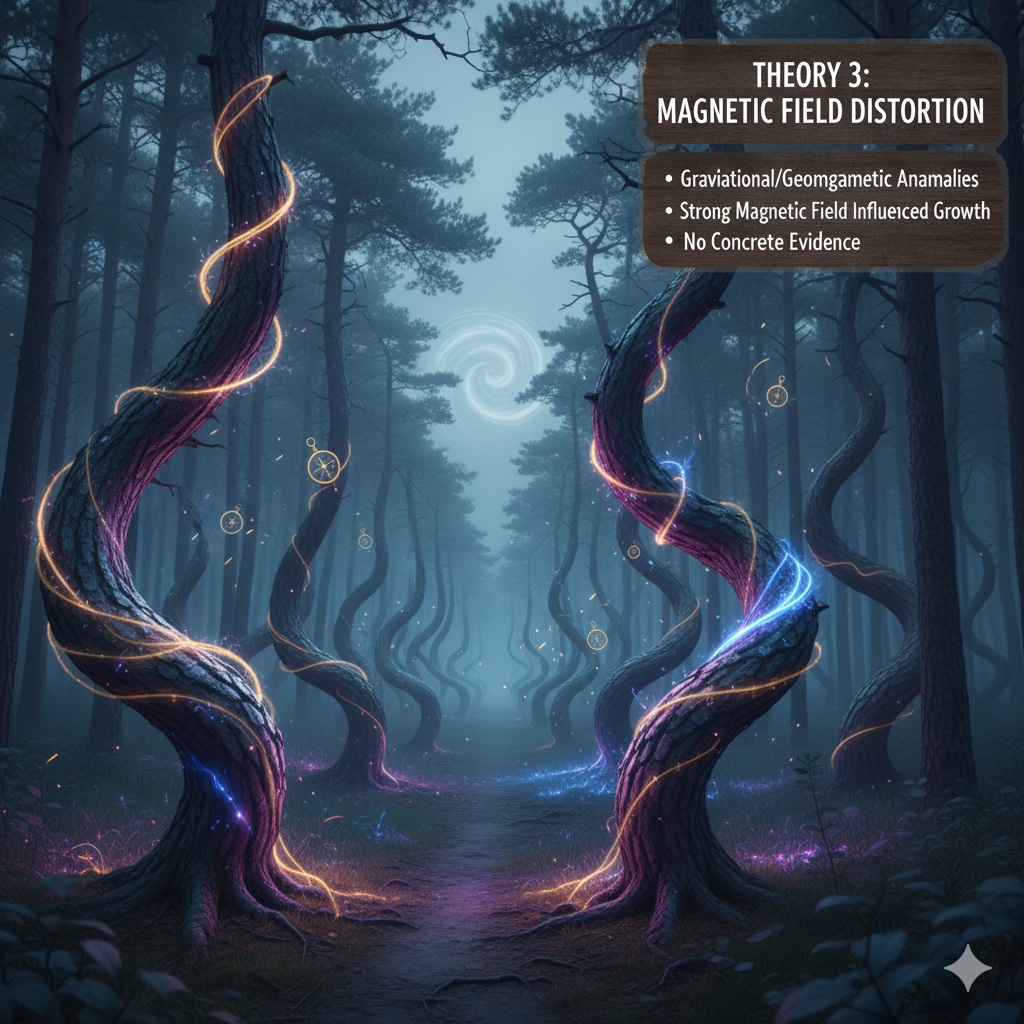
Could a strong magnetic field have influenced the growth direction of young pines?
While this theory excites the imagination, there’s no concrete evidence of magnetic interference in that region.
Theory 4: World War II Tanks or Bomb Damage
Some locals believe wartime military activity — tanks rolling over young trees or bomb blasts displacing the soil — could have bent the saplings permanently.

However, researchers argue that this would have caused chaotic destruction, not the symmetrical, graceful curves we see today.
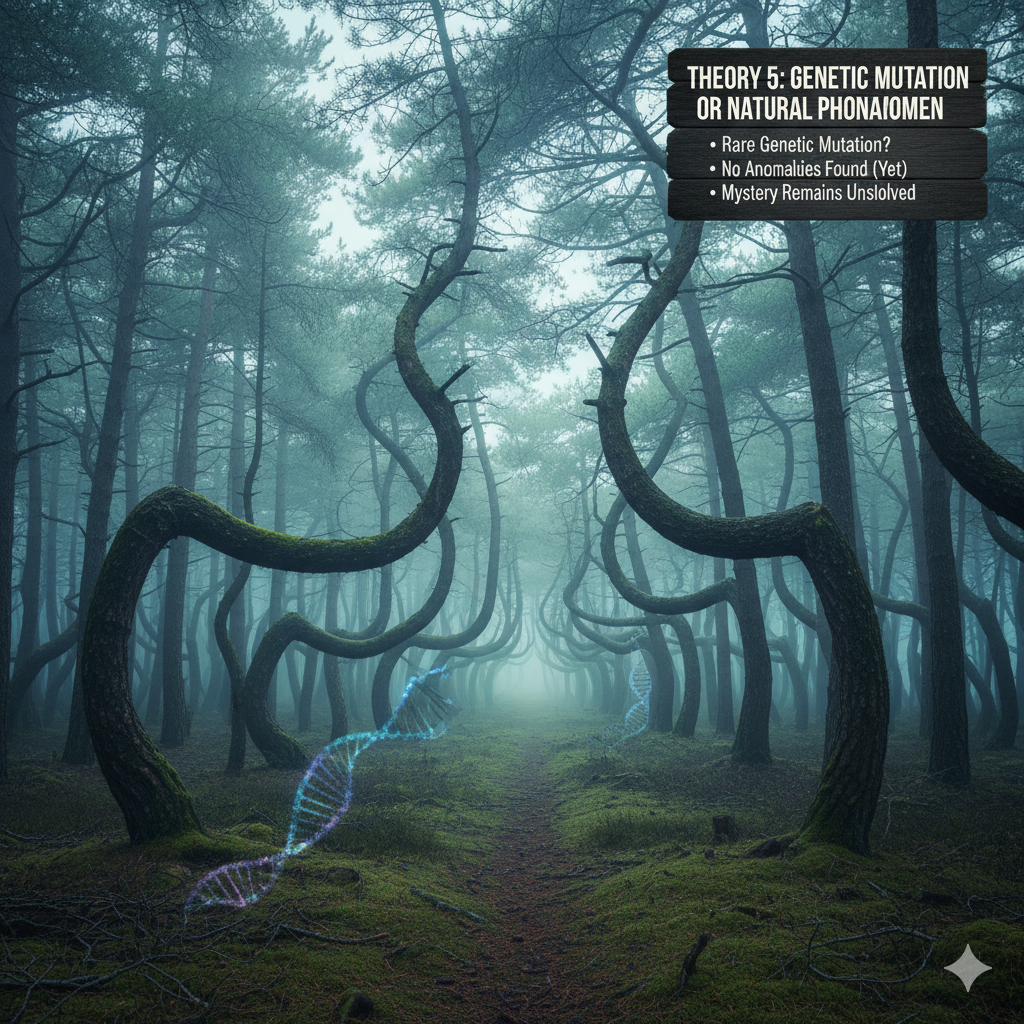
Theory 5: Genetic Mutation or Natural Phenomenon
Could this be a rare genetic mutation affecting the pines’ growth patterns?
So far, genetic testing shows no anomalies. The forest’s mystery, therefore, remains unsolved.
A Natural Work of Art: The Crooked Forest’s Aesthetic Allure
Regardless of its cause, the forest is undeniably beautiful — a real-life art installation sculpted by time and mystery.

Photographers love the Crooked Forest for its:
- Dreamlike atmosphere
- Symmetrical organic curves
- Changing light during seasons — foggy mornings, snowy winters, golden autumns
In spring and fall, when mist drapes the trees, it feels like stepping into a fantasy film set or a Tolkien novel.
No wonder it’s often dubbed:
“The Enchanted Forest of Poland.”
The Crooked Forest in Pop Culture
The Krzywy Las has become a symbol of mystery and wonder across media:

- Featured in documentaries by National Geographic and BBC Earth.
- Used in music videos and fantasy films.
- A frequent feature on travel blogs and photography contests.
- Listed among the “Top 10 Most Mysterious Places on Earth.”
It’s even inspired folklore — with stories of wizards, dragons, and magnetic curses that “bent” the forest overnight.
How to Visit the Crooked Forest
Getting There:
- From Szczecin: 30 km (about 40 minutes by car)
- From Gryfino: 4 km south — easily reached by taxi or bike
- From Warsaw: Around 6 hours’ drive
Coordinates: 53°08′42″N 14°29′00″E
There’s a small car park and walking path, with signs explaining the forest’s history.
Best Time to Visit:
- Spring (April–May): Soft green colors and mild weather
- Autumn (October): Vibrant golden tones
- Winter: Snow adds a mystical, cinematic touch
The forest is open year-round and free to visit.
Nearby Attractions
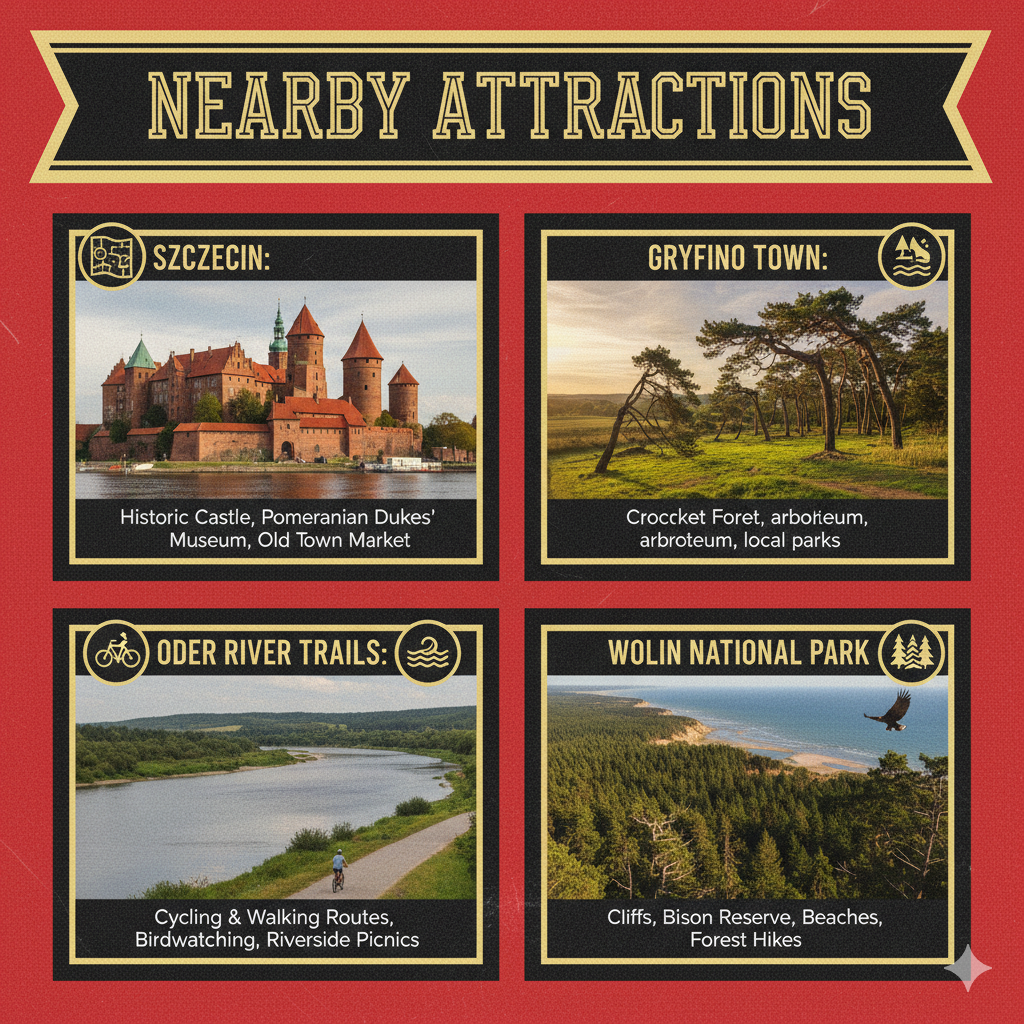
While visiting the Crooked Forest, explore these nearby gems in the West Pomeranian region:
- Szczecin: The region’s capital, rich in Gothic architecture and river views
- Gryfino Town: Cozy cafés, Polish cuisine, and small museums
- Oder River Trails: Ideal for cycling or kayaking
- Wolin National Park: Famous for cliffs, bison, and Baltic Sea views
The Science Behind Tree Bending
When a young tree bends, its growth hormones (auxins) redistribute unevenly, causing one side to elongate faster than the other.
This can create permanent curvature if maintained for years.
If humans indeed guided these bends, they may have used:
- Wooden braces,
- Ropes or weights, or
- Planted at an angle to encourage sideways growth.
Over time, as the tree matured, it grew upward again, preserving its bent base like a natural signature of intention.
Source:
Ongoing Research and Conservation
Today, the Crooked Forest is protected as a national heritage site under local conservation laws.
Researchers from the University of Szczecin continue to study the trees’ anatomy, hoping to uncover new clues.
Efforts include:
- Soil sampling
- Drone mapping and 3D modeling
- Historical aerial photo analysis
The goal is to preserve this ecological treasure for future generations while solving its enduring riddle.
Why the Crooked Forest Matters
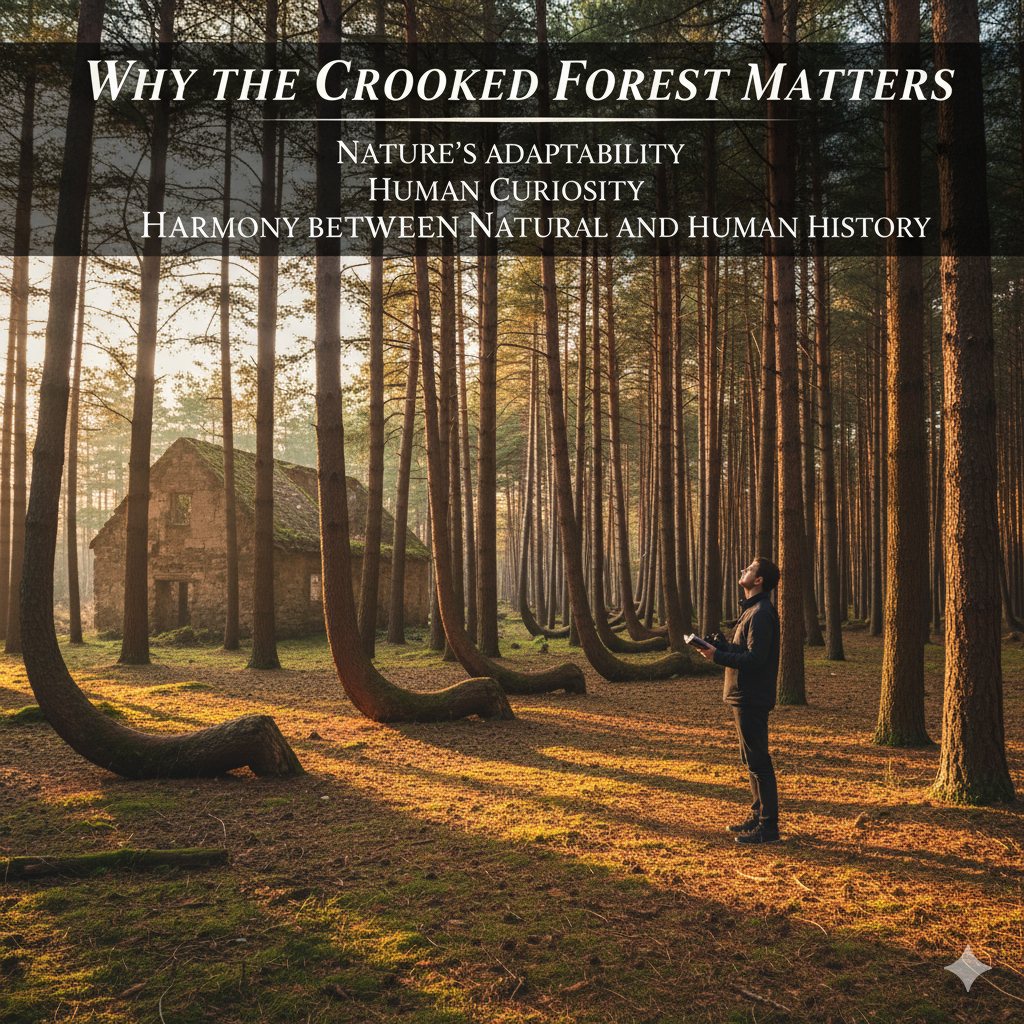
Beyond its visual mystery, the Crooked Forest is a symbol of:
- Nature’s adaptability
- Human curiosity
- Harmony between natural and human history
It reminds us that not every question needs an answer — sometimes, the magic lies in the mystery itself.
Check Also: Explore 50 Natural Wonders World’s Most Breathtaking marvels
FAQs
1. Where is the Crooked Forest located?
It’s near Gryfino, Poland, in the West Pomeranian Voivodeship.
2. How many trees are in the Crooked Forest?
Around 400 pine trees, each bent in a unique, but similar, curve.
3. Why are the trees bent?
The exact reason remains unknown, but the leading theory suggests human shaping for timber design before World War II.
4. Can tourists visit the Crooked Forest?
Yes! The site is open to the public year-round and has walking paths and signage.
5. Is the Crooked Forest a protected area?
Yes, it’s under local environmental protection to preserve its unique natural heritage.
When Nature Refuses to Be Straight
The Crooked Forest of Poland stands as a living riddle — a forest that twists logic, time, and symmetry.
Whether shaped by man, nature, or mystery, it continues to captivate dreamers and scientists alike.
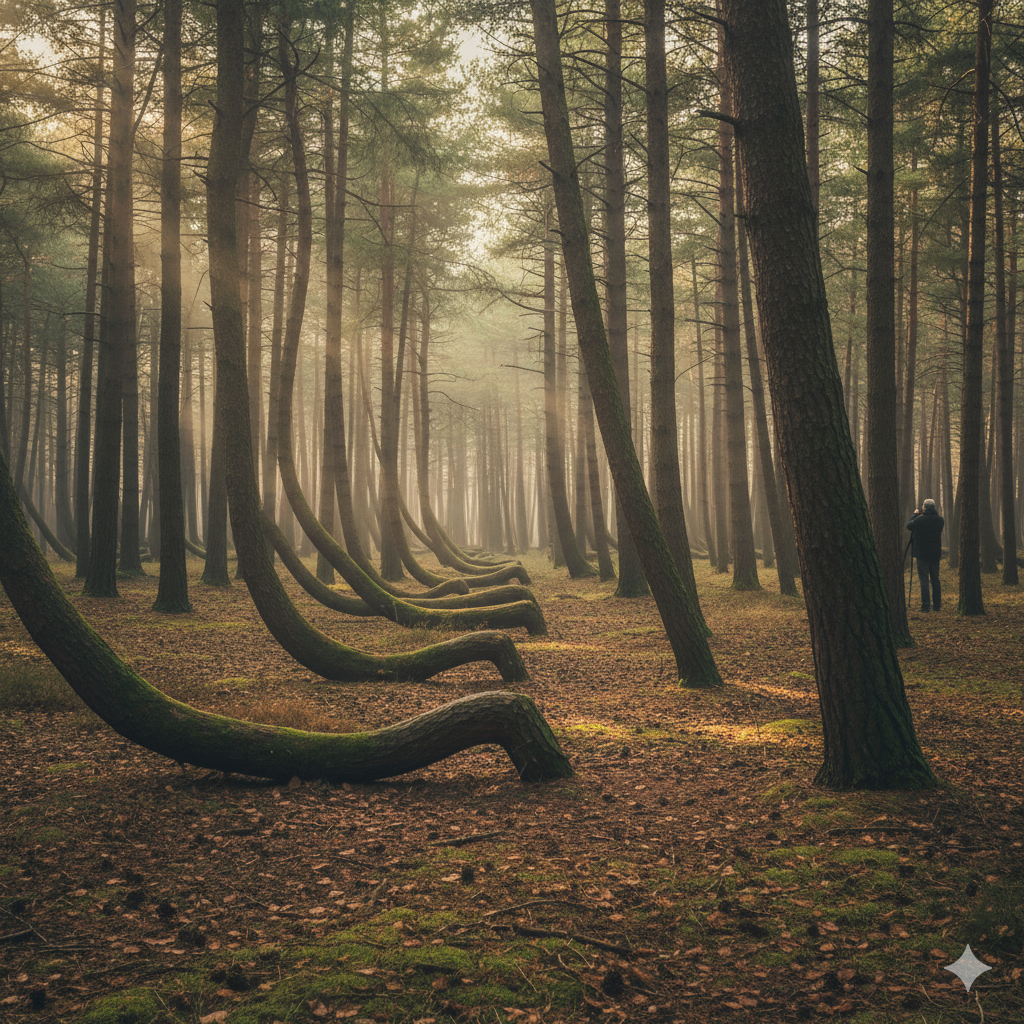
Its silent, twisted forms whisper of history, resilience, and the strange beauty hidden in imperfection.
And maybe, just maybe — that’s the forest’s real message:
“Not all mysteries are meant to be solved. Some are meant to be admired.”